





Short answer: no, not reliably. Vacuum sealing removes the air from around your food, which is excellent for freshness, freezer burn and shelf space, but removing air is not the same thing as blocking odour molecules from passing through the bag. For most kitchen use that difference never matters. For strong-smelling contents, or for anything where discretion or containment genuinely matters, it does. Here is the actual mechanism, so you can tell which situation you are in.
What a vacuum sealer actually does
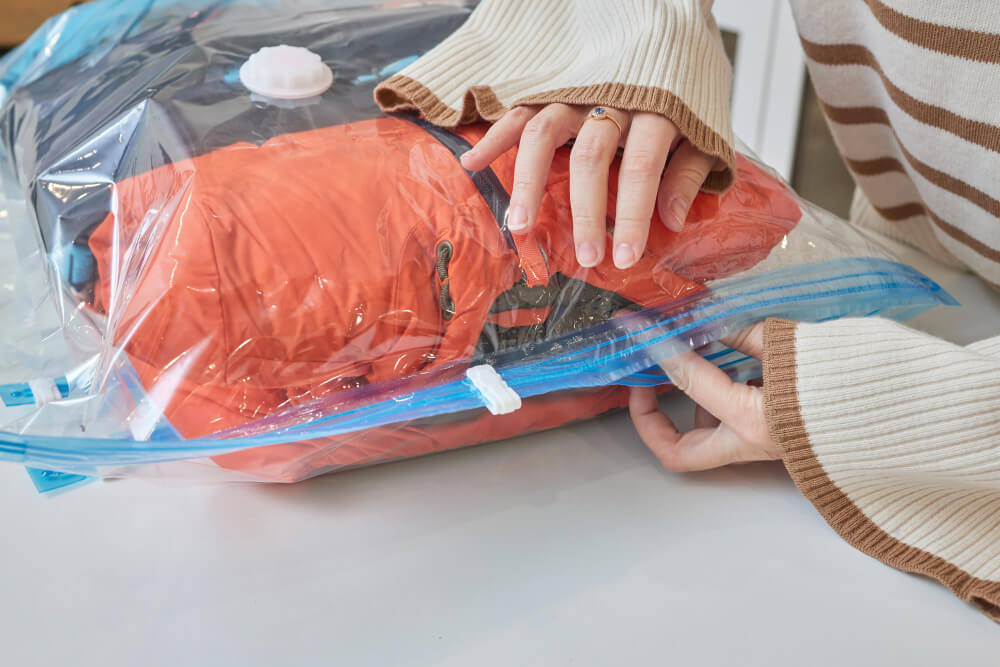
A domestic or commercial vacuum sealer does two things: it pulls the air out of the bag with a pump, then it heat-seals the open end shut. That solves the problems caused by trapped air, oxidation, freezer burn from ice crystals forming around air pockets, and it compresses the contents for storage. None of that changes the permeability of the bag film itself.
Why removing air is not the same as blocking smell
Odour is caused by volatile organic compound (VOC) molecules moving from the source, your food, into the air, and eventually to your nose. A standard vacuum-bag film, usually a multi-layer polyethylene or nylon/PE laminate, is porous to gas at a molecular level. With the air gone, there is less gas inside the bag to carry odour out in the first place, so a freshly sealed bag will smell far less than an open container. But over time, especially over days or weeks in a fridge or a pack, VOC molecules still migrate through the film itself, not just through the seal. This is a slow, continuous process rather than a leak, which is why vacuum-sealed strong-smelling food (fish, aged cheese, fermented items, game meat) can still be detected, particularly once several bags sit together in an enclosed space like a fridge shelf, an esky, or a car boot.
For the fuller explanation of what actually stops that migration, barrier laminates, activated carbon, and how it is measured, see how smell-proof bags actually work.
When a standard vacuum bag is good enough
- Freezer storage. Cold slows off-gassing significantly, and a closed freezer is not somewhere odour needs to be contained.
- Short-to-medium fridge storage of everyday food, a few days to a couple of weeks.
- Sous vide cooking, where the bag is submerged and used shortly after sealing.
- Bulk and pantry storage of dry goods with low odour.
When a standard vacuum bag is not enough
- Strong or pungent food stored for extended periods, particularly cheese, cured or smoked meat, fish, and fermented products.
- Camping, hunting and fishing, where game, fish or bait needs to stay undetectable to wildlife or fellow campers, and where bags may sit in a warm pack or vehicle for hours.
- Travel, where a bag sits compressed in luggage for a full trip.
- Non-food and industrial uses, medical waste, biohazard material, industrial or chemical odours, where containment is a compliance issue, not a convenience.
- Any use where a puncture or a poor seal is likely. A vacuum bag’s odour control depends entirely on an intact seal and film; one pinhole or a weak seam and the partial containment it did offer is gone.
Vacuum bags vs genuine odour-barrier bags
| Standard vacuum bag | Engineered odour-barrier bag | |
|---|---|---|
| Air removed | Yes | Sometimes (not the primary mechanism) |
| How it controls odour | Less trapped air to carry smell; film itself still gas-permeable over time | Barrier layer (foil, metallised film or EVOH) blocks gas migration through the film; some add activated carbon to adsorb odour molecules |
| Seal type | Heat-sealed once by the vacuum machine | Heat-sealed seam, engineered double-zip or roll-top, sometimes tamper-evident |
| Reusable | Sometimes, with a clip or resealable channel | Purpose-built reusable formats available with reinforced closures |
| Best for | Freshness, freezer burn, space saving | Genuine odour containment: strong-smelling contents, discretion, compliance |
Getting the most odour control out of a vacuum bag
- Use a thicker, multi-layer bag rather than the thinnest option, since gas migration slows with more and denser layers, even without a dedicated barrier layer.
- Check the seal every time, run a finger along it, and reseal if you see any gap or wrinkle in the seam.
- Avoid overfilling, which stresses the seal at the point where it is folded to seal, a common source of pinhole leaks.
- Double-bag strong contents, a vacuum-sealed bag inside a second sealed bag or container, for anything you genuinely cannot risk being detected.
- Store it cold, since VOC release accelerates with temperature; a warm car or backpack will out-perform a cold fridge for the wrong reasons.
- Move to a purpose-built barrier bag once you are relying on a vacuum bag to do a job it was not designed for.
How Carewell Group helps
Carewell Group is an Australian packaging manufacturer and supplier. Where a standard vacuum bag is not enough, we engineer the right alternative rather than selling a generic bag off a shelf:
- Barrier and lining selection matched to the product, activated carbon, foil or metallised film, or multi-layer poly/nylon laminates.
- Heat-sealed seams, double-zip locks, roll-tops or tamper-evident closures depending on how the bag will be used and reused.
- Custom sizing and branding, from sample pouches to bulk industrial formats.
See the full detail on custom-engineered odour control bags, and the underlying science in how smell-proof bags actually work. This supports food manufacturers and meal-prep operations (food fulfilment packaging), pet product businesses (pet food packaging), and standard vacuum and poly bag supply through our poly bags and mailers range.
Carewell can meet all your packaging needs for your business. Talk to our expert and we will work to your required MOQ. Call +61 (02) 8760 1491 or request samples and a specification review.
Frequently asked questions
Are vacuum sealed bags smell proof?
Not reliably. They reduce odour by removing trapped air, but the film itself remains gas-permeable, so strong or long-stored odours can still migrate through over time. True odour-proof performance needs a barrier film such as foil, metallised film or EVOH.
Can I make a vacuum bag more smell proof?
Use a thicker multi-layer bag, check the seal carefully, avoid overfilling, store cold, and double-bag for strong contents. These reduce but do not eliminate odour transmission.
Why does vacuum-sealed fish or cheese still smell?
Because vacuum sealing removes the air, not the permeability of the film. Odour molecules continue to migrate slowly through the bag material, which becomes noticeable with strong-smelling food over time or when several bags are stored together.
What should I use instead for strong-smelling items?
A purpose-built odour-barrier bag with a foil, metallised or EVOH barrier layer, sometimes with an activated carbon lining, and an engineered closure rather than a standard vacuum seal alone.
Is vacuum sealing still worth it for food storage?
Yes, for freshness, reduced freezer burn and space saving it is excellent. It is a food-preservation tool first and an odour-reduction tool second, not a dedicated odour-barrier product.
Sources
- ASTM D3985, oxygen gas transmission rate through plastic film: astm.org
- ASTM E96 / ASTM F1249, water vapour transmission rate of materials: astm.org
Written by Alif Vasaya, digital and content strategy, Carewell Group. Carewell Group is an Australian packaging, food packaging, tape, industrial safety and 3PL supplier serving all of Australia. Last updated 14 September 2026.