





Quick Summary: Wheel chocks are non-negotiable safety devices for trucks, trailers, mining equipment, and commercial vehicles. In this guide, we cover everything — what wheel chocks are, which type you need, Australian safety standards, how to use them correctly, and how Carewell Group can engineer a custom solution for your operation.
Table of Contents
1. What Are Wheel Chocks?
A wheel chock (also called a tyre chock or vehicle chock) is a wedge-shaped block placed against a vehicle’s tyre to prevent it from rolling or moving when stationary. They are one of the most fundamental yet most underestimated safety tools in industrial, commercial, and transport environments.
Whether you are operating a busy loading dock in Western Sydney, managing a mining site in the Pilbara, running a transport fleet in Perth, or maintaining a construction site in Brisbane — wheel chocks are your first line of defence against uncontrolled vehicle movement.
The concept is simple. The impact is life-saving.
Every year in Australia, vehicle rollaway incidents at workplaces result in serious injuries, deaths, and millions of dollars in damage to equipment and infrastructure. SafeWork Australia and state-based WHS regulators consistently list unsecured vehicles as a preventable cause of workplace incidents — and wheel chocks are the primary, low-cost countermeasure.
2. Why Wheel Chocks Matter: The Real Cost of Not Using Them
The Safety Case
When a vehicle is parked on a slope, loaded or unloaded at a dock, or left unattended during maintenance, its parking brake alone may not be sufficient to hold it in place. Worn brake pads, a slight mechanical failure, vibration from nearby machinery, or even a gradient as mild as 1–2 degrees can cause a multi-tonne truck or trailer to move.
Even on a flat surface, vibrations from forklifts, loading equipment, or nearby traffic can cause slow, silent rollaway events that workers may not notice until it is too late.
The consequences of an unsecured vehicle rollaway include:
- Crush injuries or fatalities to workers
- Damage to forklifts, dock levellers, and loading equipment
- Destruction of goods and inventory
- Structural damage to warehouse and dock infrastructure
- Significant legal liability, WHS penalties, and insurance claims
- Business interruption costs
The Compliance Case
In Australia, the Work Health and Safety Act 2011 and supporting WHS Regulations impose a duty of care on businesses to eliminate or minimise workplace hazards, including the risk of vehicle movement. Failing to implement adequate vehicle immobilisation procedures — which includes the use of wheel chocks — can result in:
- Improvement Notices from SafeWork NSW, WorkSafe VIC, or equivalent state bodies
- Prohibition Notices that shut down operations
- Infringement fines for the business and individual officers
- Prosecution under WHS laws in the event of a serious incident
The cost of a quality set of wheel chocks is trivial compared to the cost of a single compliance failure.
3. Types of Wheel Chocks Explained
Not all wheel chocks are created equal. The right type depends on your vehicle class, surface type, environment, and load requirements. Here’s a breakdown of all the major types available in the Australian market:
Rubber Wheel Chocks
Rubber chocks are the most traditional and widely available type. Made from solid or recycled rubber, they offer excellent grip on most surfaces and a reasonable level of durability. They are commonly found in automotive workshops, service stations, and light commercial settings.
Best for: Passenger vehicles, light commercial vans, utility trailers
Pros: Widely available, affordable, good surface grip
Cons: Can deteriorate under prolonged UV exposure, oil, and chemical contact; heavier than polyurethane equivalents
Polyurethane (Urethane) Wheel Chocks
Polyurethane wheel chocks — often simply called urethane chocks — represent the premium end of the non-metallic chock category. They are manufactured from cast or moulded polyurethane, giving them a unique combination of lightweight handling, outstanding durability, and exceptional resistance to oils, fuels, chemicals, and UV radiation.
This is why urethane chocks are the preferred choice for industrial operations, transport fleets, and mining environments. They do not absorb moisture, do not rust, and maintain their structural integrity even after years of outdoor use in harsh Australian conditions — whether in the heat of the Pilbara or the cold and wet of a Melbourne winter.
Best for: Trucks, heavy vehicles, industrial and mining applications, outdoor fleet management
Pros: Lightweight, chemical and oil resistant, UV stable, long service life, excellent load capacity
Cons: Higher initial cost than rubber (offset by far greater lifespan)
At Carewell Group, our urethane chock range is available in three variants to match your vehicle class:
- Urethane Chock Small — Compact and lightweight, ideal for utility trailers, motorcycles, and smaller passenger vehicles where easy portability is important.
- Urethane Chock Medium — Engineered for 4WDs, vans, and light-duty trucks. Delivers enhanced grip, high visibility colouring, and improved stability for day-to-day commercial use.
- Urethane Chock Medium-Heavy — Designed for applications where chemical and oil contact is routine. Built with high-pressure resistance and reinforced construction, this variant performs reliably on gravel, asphalt, and concrete in demanding industrial environments.
Plastic Wheel Chocks
Plastic wheel chocks — typically made from high-density polyethylene (HDPE) — are lightweight and cost-effective. They are suitable for lighter vehicle classes and indoor environments where chemical resistance and extreme load capacity are not critical requirements.
Best for: Car parks, small passenger vehicles, indoor use
Pros: Very lightweight, low cost
Cons: Lower load capacity, less durable in outdoor conditions than urethane alternatives
Steel Wheel Chocks
Steel chocks are the heavy-duty option for extreme industrial and specialised applications. Their strength-to-size ratio is unmatched, making them the choice for very large off-road equipment, military vehicles, and situations where maximum holding force is required.
Best for: Mining haul trucks, military vehicles, very heavy construction equipment
Pros: Extremely high load capacity, very robust
Cons: Heavy, prone to corrosion without coating, can damage tyres and surfaces if not used correctly
Wheel Chocks with Handle
Wheel chocks with handles are a category that adds a practical ergonomic feature — a robust handle integrated into or attached to the chock body. In high-traffic logistics environments, loading docks, and transport hubs where workers are placing and removing chocks dozens of times per day, the handle dramatically reduces bending, awkward posture, and manual handling strain.
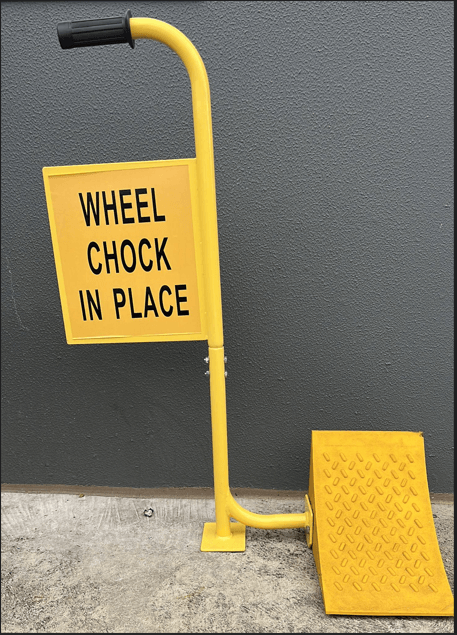
Carewell Group’s Truck Wheel Chock with Handle and Sign is our flagship handled chock. It combines a durable aluminium construction with an ergonomic handle and an integrated “Chock Your Wheels” safety sign — making it not just a physical barrier but an active visual communication tool for workplace safety compliance.
Best for: Loading docks, commercial transport hubs, truck and trailer operations
Pros: Ergonomic, fast deployment and retrieval, integrated safety signage
Cons: Higher unit cost than basic chocks — cost is justified in high-use environments
Wheel Chocks with Rope / Chain
Some wheel chock models include a rope, chain, or lanyard connecting a pair of chocks. This allows one chock to be placed on either side of the tyre simultaneously, and provides a convenient means of storing and retrieving them without them being left on the ground as trip hazards.
Best for: Transport drivers, fleet operators
Pros: Paired protection, easy retrieval, reduces loss
Cons: Rope can degrade in harsh outdoor conditions
Automatic / Mechanical Wheel Chock Systems
Automatic wheel chock systems are fixed mechanical devices installed at loading dock positions. They engage automatically when a vehicle reverses to the dock and release only when the vehicle is clear. These systems are often integrated with dock communication lights to signal to the driver that the chock is engaged or disengaged.
Best for: High-throughput loading docks, warehouses with a permanent dock infrastructure
Pros: No manual intervention required, very consistent engagement, compatible with dock safety interlock systems
Cons: High installation cost, requires maintenance, fixed position
Mining Truck Wheel Chocks
Mining operations present unique and extreme demands on wheel chocks. Haul trucks operating in open-cut mining can weigh anywhere from 90 tonnes to over 400 tonnes (loaded). Standard wheel chocks are wholly inadequate for these vehicles.
Mining wheel chocks are purpose-built for the extremes of mining environments:
- Engineered for extreme load ratings matching the specific haul truck fleet
- Designed to resist degradation from oil, diesel, and hydraulic fluid spills common on mine sites
- High-visibility colour coding (typically yellow or orange) for mine site safety compliance
- Often fitted with chains, lanyards, or storage brackets on the vehicle itself
- Compliant with mining-specific safety standards and site procedures
If your operation involves haul trucks, dozers, excavators, or other heavy mining equipment, a custom-engineered mining chock is not optional — it is a safety-critical specification. Carewell Group’s engineering capability means we can produce custom mining chocks to your exact vehicle and site requirements.
4. How to Choose the Right Wheel Chock
Selecting the correct wheel chock is a safety-critical decision. Here is a practical framework:
Step 1: Identify Your Vehicle Class
The gross vehicle mass (GVM) or gross combination mass (GCM) of the vehicles you are chocking determines the minimum load rating your chock must meet.
| Vehicle Type | Approximate Weight | Recommended Chock Type |
|---|---|---|
| Motorcycles, ATVs | Under 500 kg | Urethane chock small |
| Passenger cars, SUVs | 1,000–3,500 kg | Urethane chock small/medium |
| Light commercial vans | 3,500–6,000 kg | Urethane chock medium |
| Rigid trucks, bus | 6,000–18,000 kg | Urethane chock medium-heavy |
| Semi-trailers, B-doubles | 18,000–68,000 kg | Heavy duty truck chock |
| Mining haul trucks | 90,000 kg+ | Custom engineered chock |
Step 2: Consider the Surface
The surface your chock will be used on significantly affects the grip and stability required.
- Smooth concrete or asphalt: Most chock types perform well
- Gravel, dirt, or uneven ground: Choose chocks with wide, aggressive base profiles for more contact area
- Wet, oily, or contaminated surfaces: Urethane chocks with textured undersides are critical — rubber chocks can slip on contaminated surfaces
Step 3: Assess the Environment
- Outdoor, high UV: Urethane and coated steel options. Rubber and standard plastics degrade faster under sustained UV.
- Chemical exposure (oil, fuel, hydraulic fluid): Urethane chocks are oil-resistant. Standard rubber can swell and lose grip when saturated with fuel or oil.
- Extreme heat: Mining and construction sites in Northern Australia require materials that maintain structural integrity at high ambient temperatures.
Step 4: Consider Handling and Storage
- High-frequency use environments (loading docks): Handled chocks reduce manual handling injuries
- Vehicle-mounted storage: Chocks with rope/chain or bracket mounting ensure they are always with the vehicle
- Colour coding: High-visibility yellow is standard in Australian industrial settings; custom branding colours are available
Step 5: Custom Engineering for Non-Standard Needs
If your vehicles, surfaces, or operational requirements do not fit standard catalogue specifications, Carewell Group’s engineering team can design and produce custom chocks from scratch. This is common in mining, aviation, and specialised heavy transport.
5. How to Use Wheel Chocks Correctly (Step-by-Step)
Even the best wheel chock provides no protection if it is used incorrectly. Here is the industry-standard procedure:
Before You Start
- Select the right size and rated chock for your vehicle (see section above)
- Inspect the chock for cracks, damage, or deformation before each use — a damaged chock may fail under load
- Inspect the ground surface — remove loose gravel, debris, or fluid contamination if possible
Placing the Chock
Step 1: Park the vehicle and apply the handbrake / park brake.
Step 2: Turn off the engine if appropriate to the task.
Step 3: Place the chock(s) against the tyre on the downhill side on a slope, or on both the front and rear of a tyre on flat ground for maximum security.
Step 4: Position the chock as close to the tyre contact patch as possible — there should be no gap between the chock face and the tyre.
Step 5: Ensure the chock is stable and will not tip over when force is applied.
Step 6: For paired operations (e.g., loading dock), always chock at least one wheel on each axle, preferably the rear axles. Many sites require front and rear chocking of at least two wheels.
Step 7: If using a chock with a handle, use the handle — do not bend down and push the chock under the tyre with your hands.
Step 8: Display or activate any visual warning signals (such as the “Chock Your Wheels” sign on the Carewell handled chock) or dock communication lights.
Removing the Chock
Step 1: Confirm that personnel are clear of the vehicle and that loading/unloading/maintenance is complete.
Step 2: Check that the driver is in the cab and ready to move.
Step 3: Remove the chock using the handle or rope — never kick chocks out from under tyres.
Step 4: Store the chock in the designated holder, vehicle bracket, or storage location — never leave chocks on the ground where they become trip hazards.
How Many Chocks Do You Need?
The minimum standard for most industrial and logistics applications:
- Single vehicle on flat ground: Minimum 2 chocks (front and rear of one wheel)
- Vehicle on a slope: Minimum 2 chocks on the downhill wheels
- Semi-trailer at a loading dock: Minimum 2 chocks on the rear axle(s)
- Mining or heavy plant: Always follow the site-specific Safe Work Method Statement (SWMS); minimum 2 chocks, often 4 for large equipment
6. Wheel Chocks for Specific Industries
Transport & Logistics
The transport and logistics sector is the highest-volume user of wheel chocks in Australia. With thousands of loading dock interactions happening every day across Sydney, Melbourne, Brisbane, Perth, and beyond, the risk of truck and trailer rollaway is a constant operational concern.
Key requirements in transport and logistics:
- Handled chocks for fast, ergonomic deployment at docks
- High-visibility colouring for dock safety management
- Durable construction to withstand daily repeated use
- Compliance with site safety induction procedures
Carewell Group’s Truck Wheel Chock with Handle and Sign is specifically engineered for this environment. The integrated signage reinforces the “Chock Your Wheels” culture that leading logistics operators have embedded in their safety programs.
Construction & Civil Works
Construction sites present dynamic, changing ground conditions — loose fill, slopes, wet surfaces, and heavy equipment operating in close proximity. Wheel chocks on construction sites must function reliably in conditions that would render lesser products ineffective.
Key requirements in construction:
- Wide base profile for stability on uneven and loose surfaces
- Oil and chemical resistance (diesel and hydraulic fluid spills are common)
- Durability against rough handling and site conditions
Mining
The mining sector in Australia — particularly in Western Australia, Queensland, and the Northern Territory — operates some of the world’s largest trucks and heaviest earthmoving equipment. Standard wheel chocks are not appropriate for this environment.
Key requirements in mining:
- Custom load ratings matching the specific haul truck specification (e.g., Caterpillar 785, 793, or Komatsu 830E)
- Mine-site colour coding compliance (typically yellow or orange)
- Resistance to harsh chemical, oil, and dust conditions
- Chain or lanyard attachment for positive control
- Compliance with mine site safety management systems
Carewell Group can engineer custom mining wheel chocks to any specification — including custom engraving, colour, load rating, and attachment hardware.
Automotive Workshops & Fleet Maintenance
In automotive workshops, the key risk is vehicles moving during service operations — particularly for brake work, wheel bearing replacement, or any task that involves removing wheels. Floor surfaces in workshops are often contaminated with oil and water.
Key requirements in automotive:
- Oil-resistant undersides that grip on contaminated workshop floors
- Range of sizes to accommodate different vehicle types in the fleet
Aviation Ground Handling
Aviation wheel chocks are a highly specialised category. Aircraft chocks must be appropriate for the weight of the aircraft, the shape of the tyre (much larger diameter than road vehicles), and the surfaces found on aprons and taxiways.
Carewell Group’s custom engineering capability extends to aviation applications for ground handling operations and private aviation facilities.
Warehousing & Distribution Centres
Modern distribution centres often operate a mix of dock-leveller systems, forklift operations, and high-density racking that leaves little margin for vehicle movement incidents. Many leading 3PL operators in Australia have implemented mandatory chocking procedures as part of their dock safety SOPs.
7. Australian Standards & Legal Requirements
Work Health and Safety Framework
Wheel chock use in Australia sits within the broader framework of the Work Health and Safety Act 2011 (federal and harmonised state/territory versions) and the associated WHS Regulations. Key obligations include:
- Employers (Persons Conducting a Business or Undertaking — PCBUs) must identify and manage the risk of vehicle movement in the workplace
- Safe Work Method Statements (SWMS) for high-risk construction work must address vehicle immobilisation where relevant
- Workers have a duty to follow established safety procedures, including chocking procedures
Relevant Standards and Guidance
While Australia does not have a single dedicated standard for wheel chocks comparable to some other markets, the following standards and guidance documents are relevant:
- AS/NZS 4024 (Safety of machinery): Relevant where vehicles interface with machinery at loading docks
- Safe Work Australia’s Code of Practice: Managing the risks of plant in the workplace: Provides guidance on immobilising vehicles during maintenance
- Safe Work Australia’s Code of Practice: Traffic management in workplaces: Addresses vehicle movement controls including wheel chocks
- State-based WorkSafe and SafeWork guidance notes on dock safety and vehicle immobilisation
What Inspectors Look For
When SafeWork NSW, WorkSafe VIC, or other state WHS regulators inspect a workplace with vehicle operations, they typically assess:
- Whether a written procedure for vehicle immobilisation exists (e.g., SOP or SWMS)
- Whether appropriate chocks are available, accessible, and in good condition
- Whether workers are trained in correct chocking procedures
- Whether chocks are actually being used (not just available)
Carewell Group’s wheel chocks are designed to support both the physical safety requirement and the procedural compliance evidence that auditors look for.
8. Custom Wheel Chock Solutions from Carewell Group
One of Carewell Group’s key points of difference in the Australian wheel chock market is our custom engineering capability. We do not simply re-sell imported catalogue products. We work with you to understand your operational requirements and engineer a solution that fits your specific vehicles, surfaces, environment, and brand.
What Custom Wheel Chocks Can Include
Custom sizing: We can produce chocks in any dimension to match the tyre profile and diameter of your specific vehicle fleet — from small utility trailers to the largest mining haul trucks.
Custom load ratings: Our engineering team specifies materials and dimensions to achieve the load rating your vehicles require, with appropriate safety factors built in.
Custom materials: Polyurethane, rubber compounds, HDPE, aluminium, steel, or combination constructions — chosen to match your environmental conditions.
Custom colour: Any RAL or Pantone colour. Yellow and orange are standard for Australian industrial safety applications. Custom colours can match your company’s safety colour scheme.
Custom branding and engraving: Your company name, logo, site identifier, or safety messaging can be moulded, engraved, or branded into the chock. This is particularly valuable for mine sites and large transport fleets where asset identification and safety culture reinforcement are important.
Custom handles and attachments: Ergonomic handle designs, rope attachment points, chain anchor eyes, vehicle-mounting brackets — whatever your operational workflow requires.
Custom signage integration: Like our flagship Truck Wheel Chock with Handle and Sign, we can integrate safety signage directly into the chock unit.
The Carewell Custom Process
Getting a custom wheel chock solution from Carewell Group is straightforward:
- Tell us your requirements — vehicle type, GVM/GCM, surface type, environment, frequency of use, any specific standards or site requirements. No requirement is too complex or unusual.
- Expert consultation — our team reviews your brief and recommends the optimal material, geometry, and construction approach.
- Digital design and approval — we produce a digital design for your review and approval before production begins. This eliminates costly errors and ensures the product meets your needs.
- Precision manufacture — production to strict quality standards, with QC checks on dimensions, load properties, and surface finish.
- Delivery and support — we deliver to your location across Australia and provide ongoing support for future orders.
Minimum order quantities are flexible — we work with businesses from single-site operators needing a small batch of custom chocks, to national fleet operators needing thousands of units across multiple sites.
9. Carewell Group’s Wheel Chock Range
Carewell Group supplies a curated range of wheel chocks covering the most common industrial and commercial applications in Australia. Our products are selected and engineered for Australian conditions and compliance requirements.
Urethane Chock – Small
Our entry-level urethane chock for lighter vehicles. Compact and lightweight with excellent grip, this is ideal for utility trailers, motorcycles, compact cars, and applications where portability is a priority.
- Material: Cast polyurethane
- Colour: High visibility yellow
- Application: Light vehicles, utility trailers, motorcycles
Urethane Chock – Medium
Engineered for the 4WD, van, and light truck market. Enhanced grip, improved stability, and high-visibility colour coding make this the go-to choice for commercial vehicle operations. Suitable for vehicles up to approximately 10 tonnes GVM.
- Material: Cast polyurethane
- Colour: High visibility yellow
- Application: 4WDs, vans, light commercial trucks
Urethane Chock – Medium Heavy
Our most robust non-handled urethane chock, designed for environments where chemical and oil contact is expected. The reinforced construction and high-pressure resistance make this the right choice for transport depots, fuel distribution, and industrial maintenance operations.
- Material: Premium cast polyurethane, oil-resistant compound
- Colour: High visibility yellow
- Application: Industrial trucks, chemical and fuel handling, transport depots
Truck Wheel Chock with Handle and Sign
$313.50 | In Stock
Our flagship heavy-duty wheel chock, combining premium aluminium construction with an ergonomic handle and integrated “Chock Your Wheels” safety signage. Engineered for daily, high-frequency use at commercial loading docks, transport hubs, and industrial sites handling trucks and trailers.
Key features:
- Durable aluminium construction for long service life
- Ergonomic handle for safe, easy placement and removal
- Integrated “Chock Your Wheels” safety sign — supports site safety culture and compliance
- Suitable for trucks, semi-trailers, and large commercial vehicles
- Highly visible for dock and site safety management
👉 Order the Truck Wheel Chock with Handle and Sign
🔴 READY TO ORDER OR REQUEST A QUOTE? Whether you need standard stock chocks delivered fast, or a custom-engineered solution for your fleet or mine site — Carewell Group has you covered. 📞 Call us: 02 4415 9165 ✉️ Email: info@carewellgroup.com.au 📍 Visit: Unit 27/191 McCredie Rd, Smithfield NSW 2164 Request a Free Quote →
10. Frequently Asked Questions About Wheel Chocks
General Questions
Q: What is the difference between a wheel chock and a wheel stopper?
A wheel chock is a portable wedge placed against a tyre to prevent a parked or stationary vehicle from rolling. A wheel stopper (also called a car stop or parking block) is typically a fixed or semi-permanent barrier installed in car parks to prevent a vehicle from pulling forward too far. They serve different purposes: chocks are used for safety immobilisation during operations; stoppers are used for parking bay management.
Q: Are wheel chocks legally required in Australia?
Australian WHS legislation requires businesses to manage the risk of uncontrolled vehicle movement. While the law does not always specify “wheel chocks” by name, the requirement to implement adequate vehicle immobilisation controls effectively mandates their use in most industrial and logistics environments. Specific industry codes, site-specific safety management plans, and standard operating procedures frequently specify wheel chocks as a mandatory control. Failure to use them when a vehicle incident occurs is likely to be treated as a WHS breach.
Q: How many wheel chocks do I need for a truck?
For a standard semi-trailer at a loading dock, the minimum is two chocks placed on the rear axle wheels (one per side). For slope applications, the minimum is two chocks on the downhill wheels. Many site-specific procedures require four chocks — front and rear of at least two rear axle wheels. Always follow your SWMS or site safety procedure; if no site-specific requirement exists, use at least two chocks and apply them to the rear drive axle.
Q: Can I use the same wheel chocks for different vehicles?
Only if the chocks are rated for the heaviest vehicle in the application. Using a chock rated for a light vehicle under a heavy truck is dangerous — the chock may fail or be displaced under load. If your operation involves a range of vehicle types, you may need different chock sizes. Carewell Group’s three-variant urethane range is designed to provide the right chock for each vehicle class.
Q: What is the correct position to place wheel chocks?
Chocks should be placed as close as possible to the tyre’s contact patch on the ground — ideally with the chock face making full contact with the tyre surface. On slopes, always chock the downhill side. At loading docks, chock the rear axle wheels on the side away from the dock to resist the tendency to roll forward when the dock plate is loaded.
Material & Durability Questions
Q: What is the best material for wheel chocks in industrial applications?
Polyurethane (urethane) is widely regarded as the superior material for industrial wheel chocks. It outperforms rubber in several critical areas: it is lighter, more resistant to oils and fuels, more resistant to UV degradation, and maintains its structural properties over a longer service life. For the most demanding applications — mining, heavy transport, chemical handling — a polyurethane chock with a purpose-formulated compound is the clear choice.
Q: How long do polyurethane wheel chocks last?
With normal industrial use, a quality cast polyurethane chock from Carewell Group is expected to provide many years of service. Urethane does not absorb moisture, does not corrode, and resists the UV degradation that shortens the life of rubber alternatives. The service life will depend on frequency of use and conditions, but urethane chocks typically outlast rubber chocks by a significant margin — making their higher initial cost very cost-effective over time.
Q: Can wheel chocks be used on wet or oily surfaces?
Standard rubber chocks can lose grip significantly on wet or oily surfaces — particularly a concern in automotive workshops, transport depots, and any site where fuel or hydraulic fluid spills are common. Carewell Group’s urethane chocks are formulated to maintain grip on contaminated surfaces, and our medium-heavy variant is specifically rated for high oil-exposure environments. On very contaminated surfaces, ensure the chock base is in contact with the ground surface (not floating on a layer of fluid) and position additional chocks for redundancy.
Q: Are wheel chocks UV resistant?
Rubber chocks can degrade, crack, and lose elasticity after prolonged outdoor UV exposure in Australian conditions. Carewell Group’s polyurethane chocks are UV-stabilised and maintain their structural properties in outdoor use. This is particularly important for fleets where chocks are routinely stored outside or on the rear of vehicles.
Application-Specific Questions
Q: What wheel chocks are suitable for mining trucks?
Standard catalogue chocks are not appropriate for large mining haul trucks. Mining wheel chocks must be custom-engineered to match the specific load rating, tyre diameter, and site safety requirements of your haul truck fleet. Carewell Group offers a custom engineering service for mining applications — contact us with your truck model and site requirements for a tailored solution.
Q: What are the best wheel chocks for trucks in Australia?
For standard semi-trailers and rigid trucks in Australian logistics and transport, Carewell Group’s Urethane Chock Medium-Heavy or Truck Wheel Chock with Handle and Sign are the leading options. The handled chock is ideal for loading dock operations due to its ergonomic design and integrated safety signage. For fleet operations where chocks travel with the vehicle, the urethane medium-heavy provides an excellent combination of durability, chemical resistance, and portability.
Q: Do you supply wheel chocks in Perth and Western Australia?
Yes. Carewell Group supplies wheel chocks across all Australian states and territories, including Western Australia. We understand the specific demands of the WA market — particularly the mining and resources sector — and can ship to Perth and regional WA locations. For large volume orders or custom mining applications, contact us to discuss delivery schedules and logistics options.
Q: Can wheel chocks be customised with our company logo or branding?
Absolutely. Custom branding is one of the most popular options in our custom solutions service. We can incorporate your company name, logo, safety messaging, or site identification into the chock via moulding, engraving, or branded plate attachment. This is particularly popular with mining companies, large transport fleets, and warehousing operators who want to reinforce safety culture through branded safety equipment.
Q: What are automatic wheel chocks and do you supply them?
Automatic wheel chocks are mechanical dock-mounted systems that engage and release without manual worker intervention. They are excellent for high-throughput docks where consistency of chocking is critical. If you are interested in automatic chocking systems as part of a broader loading dock safety solution, please contact Carewell Group to discuss your requirements — we can assist with sourcing and specification for these systems.
Q: Are your wheel chocks compliant with Australian standards?
Carewell Group’s wheel chocks are designed and manufactured to support compliance with Australian WHS requirements for vehicle immobilisation. Our ISO 9001:2015 quality management certification, ISO 14001:2015 environmental certification, and ISO 45001:2018 occupational health and safety certification underpin the quality and reliability of our products. For specific site or industry compliance requirements, our team can review your needs and confirm suitability.
Ordering & Custom Solutions
Q: What is the minimum order quantity for custom wheel chocks?
We work with businesses of all sizes. There is no fixed minimum for standard catalogue products. For custom-engineered chocks, minimum quantities depend on the design and manufacturing process — contact us to discuss your specific requirements and we will advise on the most cost-effective approach.
Q: How long does it take to receive custom wheel chocks?
Lead times for custom wheel chocks depend on the complexity of the design, material sourcing, and production requirements. Standard custom orders are typically completed within 4–8 weeks from design approval. Contact us for a specific timeline based on your requirements.
Q: Do you offer bulk pricing for wheel chocks?
Yes. Volume pricing is available for bulk orders of both standard and custom wheel chocks. Contact our sales team at info@carewellgroup.com.au or call 02 4415 9165 to discuss your volume requirements.
11. Get a Quote or Order Now
Ready to Secure Your Fleet and Your Site?
Carewell Group is Australia’s trusted supplier of premium wheel chocks — from our range of high-performance urethane chocks to fully custom-engineered solutions for mining, heavy transport, and specialised industrial applications.
We are ISO 9001:2015, ISO 14001:2015, and ISO 45001:2018 certified — giving you confidence that every product meets the highest standards of quality, sustainability, and safety.
What We Offer:
✅ In-stock standard urethane chocks for fast delivery across Australia ✅ Heavy-duty truck chocks with handle and sign for loading dock compliance ✅ Custom-engineered chocks for any vehicle, any surface, any industry ✅ Volume pricing for fleet and site-wide programs ✅ Expert consultation — no requirement too complex
Get in Touch Today:
📞 Phone: 02 4415 9165 ✉️ Email: info@carewellgroup.com.au 📍 Address: Unit 27/191 McCredie Rd, Smithfield NSW 2164
About Carewell Group
Carewell Group is an Australian industrial safety, packaging, and logistics solutions company headquartered in Smithfield, NSW. We supply businesses across Australia with high-quality safety equipment, packaging products, and custom-engineered solutions — backed by ISO 9001, ISO 14001, and ISO 45001 certification.
Our wheel chock range is part of our broader industrial and safety product offering, which includes safety vests, tyre depth gauges, electronic locks, load cells, and more. We also offer 3PL and logistics services through our three facilities across Sydney.
Whether you need a single set of wheel chocks delivered tomorrow or a fully custom-engineered safety solution for your mining fleet — Carewell Group is your partner.
Carewell Group Pty Ltd | Unit 27/191 McCredie Rd, Smithfield NSW 2164 | 02 4415 9165 | info@carewellgroup.com.au | www.carewellgroup.com.au