





Food co-packing, using a third party to make or pack your food product, is how a lot of Australian food brands scale without building a factory. It is a sound model for the right situation. It is also frequently reached for when the real constraint is secondary packaging, the trays, cartons and sealing after the food is made, which a brand can often run more cheaply in-house. This guide explains what food co-packing covers, how to evaluate a co-packer, and where smart in-house packaging is the better answer.
What food co-packing covers
- Primary production or filling: making the product, or filling it into its retail pack, a pouch, tray, jar, bottle or tub, and sealing it. Capital-heavy and compliance-heavy.
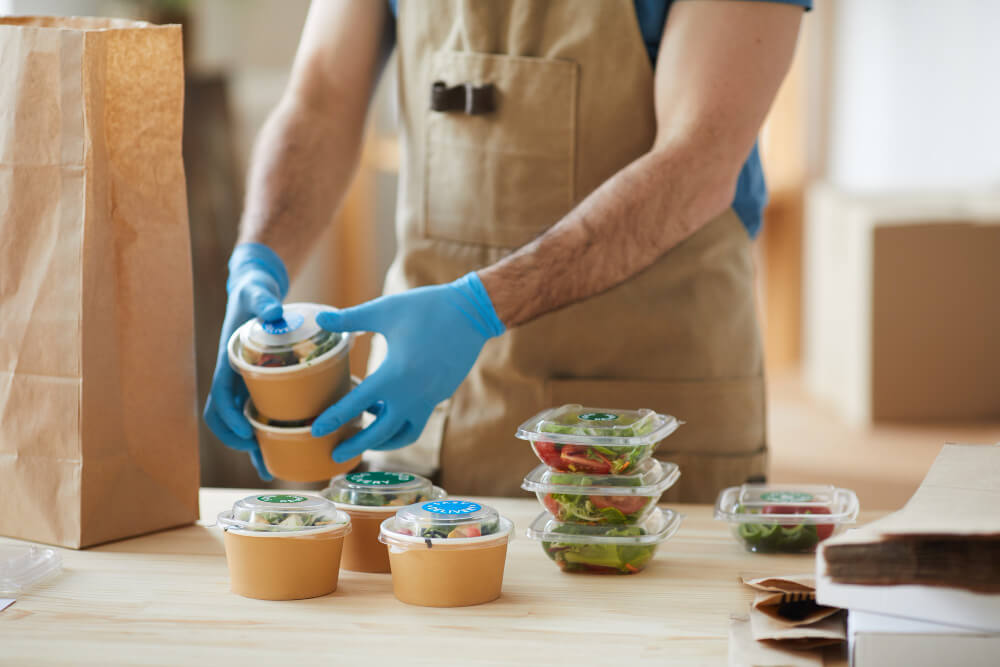
- Secondary packaging: tray sealing, lidding, labelling, sleeving, multipack bundling and cartoning.
- Tertiary packaging: casing and palletising for retail distribution.
- Storage and distribution: some co-packers hold and ship finished stock, overlapping with a 3PL.
Why food co-packing is common
- Compliance. HACCP, allergen control, and for some products a licensed facility, are demanding to establish.
- Equipment. Tray sealers, retort, blast freezing and filling lines are expensive.
- Capacity. Seasonal ranges and promotional volume that would idle owned equipment.
- Speed. A co-packer already has the line and the certifications.
These reasons apply most to primary production. The secondary packaging is where a brand usually has more room to run its own operation efficiently.
How to evaluate a food co-packer
| Check | What to ask |
|---|---|
| Certification | HACCP, and a GFSI-recognised scheme (SQF, BRCGS, FSSC 22000) if your retailer requires it. |
| Allergen management | Segregation, validated cleaning and testing between runs. |
| Format capability | Do they run your pack, tray seal, MAP, pouch, retort, and your fill weights? |
| Cold chain | Chilled and frozen storage, and temperature control through dispatch. |
| Minimums and lead time | MOQ, run length, changeover cost, and how they handle your peak. |
| Costs | Setup, run rate, materials, storage. Quote against a real production run. |
| Traceability and recall | Batch records and a tested recall process. |
For a company-by-company view, see food contract packaging companies in Australia.
Where smart in-house packaging wins
If your product is made elsewhere but you handle finishing and dispatch, or you make in-house and only need help at peak, the packaging levers you control are:
- The right tray. Match the tray material and format to the product and process: CPET for freezer-to-oven, APET or PP for chilled, compartment trays for meal formats. The wrong tray causes rework, leaks and seal failures.
- Right-sized cartons. Profile your orders and run the smallest carton range that fits, to cut dimensional-weight freight.
- One-motion sealing. A water activated tape dispenser for shipping cartons; consistent lidding film for trays.
- Cold-chain packaging sized to worst-case transit, not the average.
- A standard pack process with materials staged and a scale at the bench.
The framework for deciding each step is in contract packing versus smart in-house packaging.
How Carewell Group helps
Carewell Group is an Australian food packaging manufacturer and supplier. We are not a co-packer or food filler. We supply the packaging that makes food fulfilment work:
- APET, CPET and PP ready-meal trays, compartment trays and lidding films, right-sized to your product.
- Right-sized shipping cartons, insulated shippers, coolant and water activated tape.
- Custom print on trays, cartons and tape.
- A packaging review: tell us your product, process and freight lanes and we will specify the tray and carton range that cuts cost and rework.
Carewell can meet all your packaging needs for your business. Talk to our expert and we will work to your required MOQ. Call +61 (02) 8760 1491 or request samples and a packaging review.
Frequently asked questions
What is food co-packing?
Using a third party to make or pack your food product. It can cover primary production and filling, secondary packaging such as tray sealing and cartoning, and sometimes storage and distribution.
When should I use a food co-packer?
When primary production or filling needs certifications and equipment you cannot justify in-house, or for seasonal and promotional capacity. Secondary packaging is often cheaper to run in-house and make efficient.
What certifications should a food co-packer hold?
HACCP as a baseline, and a GFSI-recognised scheme such as SQF, BRCGS or FSSC 22000 if your retail channel requires it, plus validated allergen management.
Does Carewell do food co-packing?
No. Carewell supplies food packaging, trays, lidding films, cartons and cold-chain packaging, and can support storage and dispatch. We are not a co-packer or food filler.
Sources
- Food Standards Australia New Zealand, food safety standards: foodstandards.gov.au
- Australian Packaging Covenant Organisation: apco.org.au
Written by Alif Vasaya, digital and content strategy, Carewell Group. Carewell Group is an Australian packaging, food packaging, tape, industrial safety and 3PL supplier serving all of Australia. Last updated 10 September 2026.