





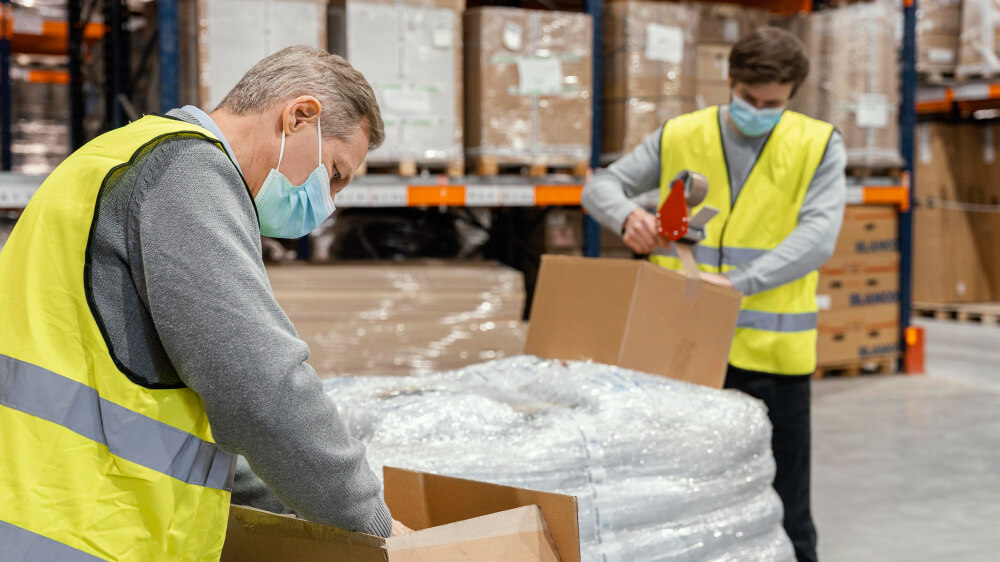
Pick and pack is the warehouse process of selecting the individual items for a customer’s order (picking) and packing them into a shipper for despatch (packing). It sits between your inventory and your customer, and it is where order speed, accuracy and packaging cost are decided. This guide explains what pick and pack means, how the process works, and how the right packaging makes an in-house pick-and-pack operation faster and cheaper.
Key points
- Pick and pack = pick the order’s items from storage, then pack them into the right shipper and seal it for despatch.
- The main pick methods are single-order, batch, zone and wave picking; the right one depends on order volume and profile.
- Packing is where most avoidable cost sits: oversized cartons, void fill, multi-pass taping and too many SKUs.
- Right-sized packaging, a fast single-pass seal and a standardised process cut pick-and-pack cost without adding staff.
- You do not need to outsource pick and pack to fix it. The packaging system usually is the fix.
What pick and pack means, step by step
- Order received. The order drops into the warehouse system as a pick list.
- Pick. A picker moves through the storage area collecting each line item, scanning as they go for accuracy.
- Consolidate. Multi-line orders are brought together at a pack station.
- Pack. The picker or packer selects a shipper sized to the order, adds protection where needed, and places the items.
- Seal and label. The carton or mailer is closed, sealed and labelled for the carrier.
- Despatch. The parcel joins the outbound consignment.
Pick methods
- Single-order (discrete) picking: one order at a time. Simple, accurate, slower per unit. Suits low volume.
- Batch picking: one picker collects the same SKU for many orders in one pass, then orders are sorted at packing. Faster for high-volume, low-line-count orders.
- Zone picking: each picker owns a zone; orders pass between zones. Suits large warehouses with many SKUs.
- Wave picking: picks are released in timed waves aligned to carrier cut-offs.
Most growing operations move from single-order to batch or zone picking as volume rises.
Where pick-and-pack cost actually leaks
The picking side is mostly about layout and method. The packing side is where money is lost, and it is a packaging problem:
- Oversized cartons. A carton bigger than the order costs more board, needs void fill, attracts a dimensional-weight freight penalty, and takes longer to pack.
- Too many SKUs. Every extra carton and mailer size is stock to hold and a decision at the pack bench.
- Slow sealing. Multiple passes of hand-held plastic tape for security add seconds to every parcel.
- Damage and returns. Under-specified board or a poor seal sends the parcel back, doubling the pick-and-pack cost for that order.
How the right packaging speeds up in-house pick and pack
- Right-size the cartons and rationalise SKUs. Match your real order profiles to the smallest shipper that protects each. Two or three carton sizes and two or three mailer sizes cover most ranges, cutting material, void fill, freight, storage and pack time together.
- Switch soft and flat goods to mailers. A paper mailer ships soft goods 20 to 40% cheaper than a box and packs faster.
- Seal in one pass. A strip of water activated tape on a dispenser seals a carton about 21% faster than a hand gun, uses about 8% less tape, and gives a stronger, tamper-evident bond.
- Design the packaging to the product. A carton or insert built to fit means drop-in, close, seal, done, with no void fill to cut.
- One supplier for the whole bench. Cartons, mailers, tape, void fill and film specified to work together removes the “sort out packaging” project.
Do you need to outsource pick and pack?
Usually not. The reasons businesses look at a third-party pick-and-pack provider, slow bench, high damage, no space, peak overload, are the same packaging-design problems above, and fixing them in-house keeps the margin and the control. A third-party provider adds a per-order fee on every order for the life of the arrangement. The full comparison is in contract packing vs smart in-house packaging.
How Carewell Group fits
Carewell Group is an Australian packaging manufacturer and supplier. We help you run pick and pack in-house at lower cost.
- Packaging review against your real order profiles to find the right-sizing, format and process changes.
- The whole pack bench from one supplier: cartons, mailers, water activated tape and dispensers, void fill and film.
- Custom design so the pack step is fast and consistent.
- Flexible minimum orders and national supply from NSW.
Carewell is certified to ISO 9001:2015, ISO 14001:2015 and ISO 45001:2018, and is an APCO member. Request a packaging review, a quote and samples or call +61 (02) 8760 1491.
Frequently asked questions
What does pick and pack mean in a warehouse?
Picking the individual items for a customer order from storage, then packing them into a shipper and sealing it for despatch.
What are the main pick methods?
Single-order, batch, zone and wave picking. The right one depends on order volume and how many lines each order has.
Where does pick-and-pack cost leak?
Mostly on the packing side: oversized cartons, too many SKUs, slow multi-pass sealing, and damage that causes returns.
How do I make pick and pack faster without hiring?
Right-size the cartons, cut SKUs, switch soft goods to mailers, seal in one pass with a dispenser, and design packaging to the product.
Should I outsource pick and pack?
Usually not. The reasons to outsource are packaging-design problems with an in-house fix that keeps the margin and control.
Written by Alif Vasaya, digital and content strategy, Carewell Group. Carewell Group is an Australian packaging, food packaging, tape, industrial safety and 3PL supplier serving all of Australia. Last updated 10 September 2026.