





Search “packaging statistics” and you’ll find the same handful of numbers repeated across hundreds of blogs: 40% of shoppers reorder because of premium packaging, 52% in another version, 61% in a newer one. Before writing this, we tried to trace every one of those figures back to an actual study. Most of them don’t hold up, the number changes depending on which blog is quoting it, and none point to a primary source you can check yourself. That’s a problem if you’re trying to make a real decision about your own packaging.
So this article does something different. It starts with the one packaging statistic every Australian business can actually verify, straight from Australia Post’s own published formula, and uses it to show exactly what a wrong-sized box costs. Then it looks honestly at what the unbranded-packaging research does and doesn’t support, rather than repeating a number nobody can source.
The one packaging statistic every business can actually verify
Every parcel carrier in Australia bills on dimensional weight, also called cubic weight, not just actual weight. Australia Post’s own guidance defines it plainly: cubic weight is calculated by measuring a parcel’s length, width and height in metres, multiplying them together, then multiplying by a cubic conversion factor of 250kg per cubic metre. The carrier then charges on whichever is greater, your product’s actual weight or its cubic weight.
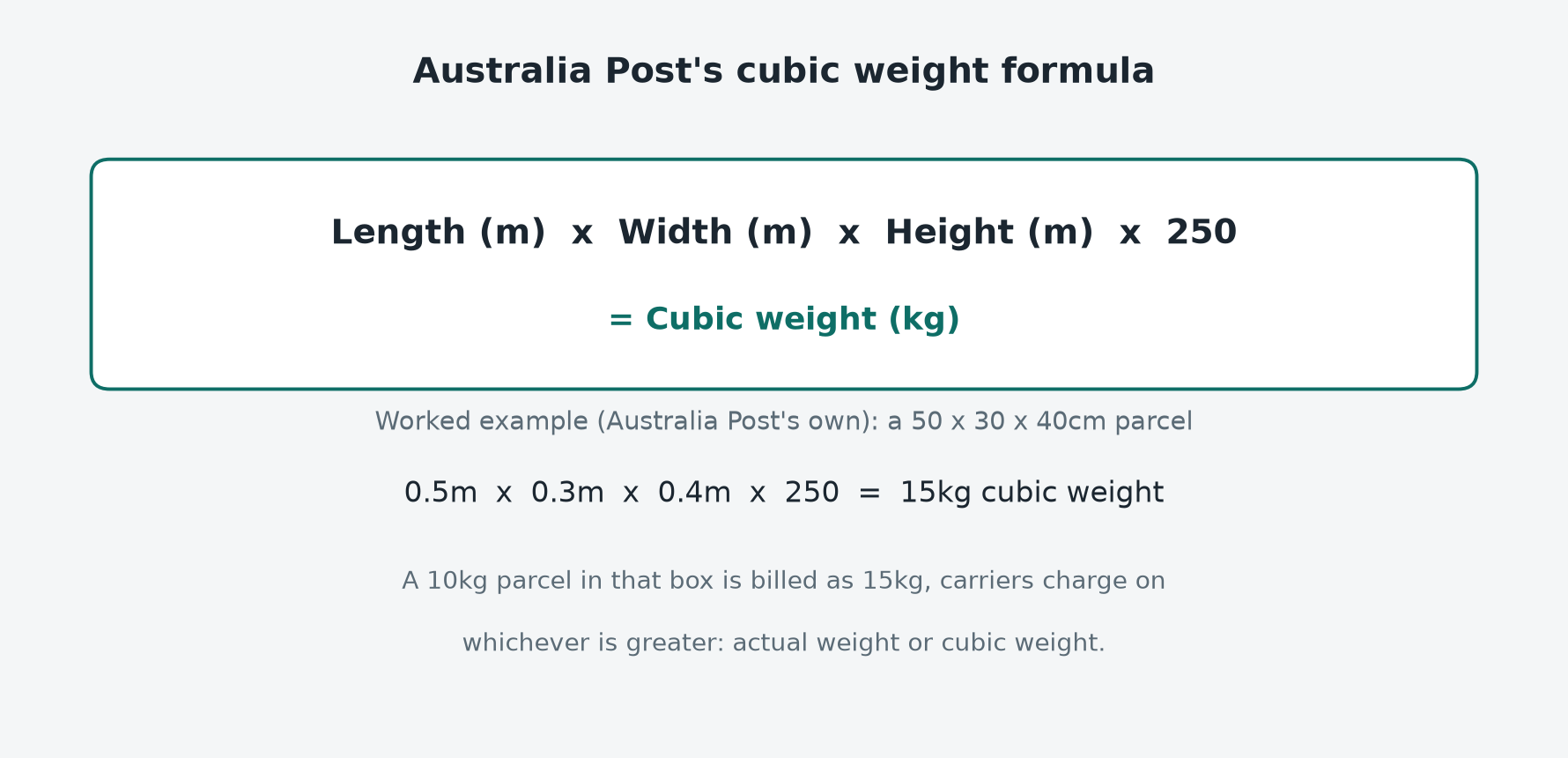
Australia Post’s own worked example makes this concrete: a parcel measuring 50cm by 30cm by 40cm works out to 0.06 cubic metres. Multiply that by the 250kg/m³ conversion factor and you get a cubic weight of 15kg. If the actual product inside that box weighs 10kg, you are billed for 15kg, 50% more than what the product actually weighs, purely because of the box size chosen around it.
What getting the box size wrong actually costs
Applying that exact formula to the same 10kg product in three different box choices shows how quickly this compounds.
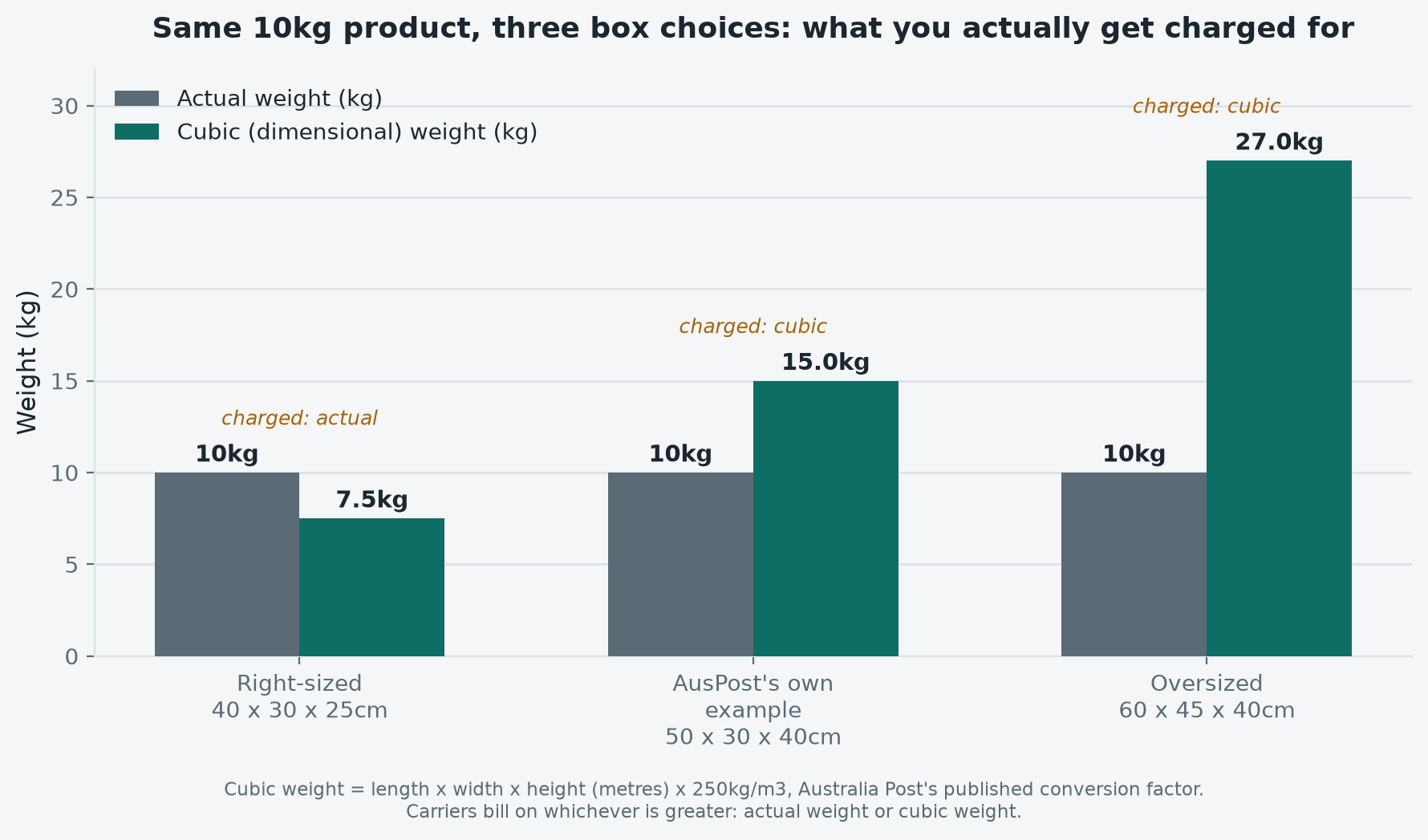
In a right-sized box, cubic weight comes in under actual weight, so you’re billed on the product’s real 10kg and the box size costs you nothing extra. In Australia Post’s own example box, cubic weight overtakes actual weight and you’re billed 50% more. In a genuinely oversized box, a plausible choice for a business “playing it safe” with extra room, cubic weight reaches 27kg, nearly triple the product’s real weight. None of this is a one-off cost. It repeats on every single parcel shipped in that box, for as long as the box choice goes unreviewed.
Why most “packaging statistics” you’ll read elsewhere can’t be verified
The oft-repeated claim that a fixed percentage of shoppers reorder because of premium packaging traces back, in different forms, to Dotcom Distribution’s annual e-commerce packaging surveys. The trouble is which figure you land on depends entirely on which secondary site is citing it: one blog reports 40%, another attributes 52% to a different study (Retail Dive, not Dotcom), a newer one claims 61% from Dotcom’s “2025 research” without a traceable source. These are stated purchase intentions from survey respondents, not measured sales lift, and the inconsistency between sources makes any single number worth treating with real scepticism rather than repeating as fact.
The same caution applies to oversized-packaging savings claims. Figures from 15% to 40% in potential freight savings circulate online, but they come almost entirely from vendors selling packaging or right-sizing services, who have an obvious incentive to emphasise the upside, and the baselines being compared are rarely stated clearly enough to check.
What the more carefully reported research does show
Stripping out the unverifiable percentages, a few findings are at least traceable to a named, dated source, with their limitations intact.
- Dotcom Distribution’s 2015 packaging survey found that 35% of respondents had watched an unboxing video online, and of those, 55% said the video convinced them to buy the product. The same survey found shoppers were 1.5 times more likely to share a photo or video on social media after receiving a gift-like box rather than a plain brown one. These are self-reported behaviours from a single dated survey, not a controlled before-and-after comparison, worth reading as directional rather than definitive.
- A Clemson University study run with paper manufacturer Seaman Paper gave 120 participants one of four interior packaging fillers, branded tissue paper, plain white tissue, air pillows, or kraft void fill, and found tissue paper of either kind produced a more positive response than air pillows or void fill. The result says more about packaging material and presentation generally than about branding specifically, and the study was sponsored by a company that sells tissue paper, worth factoring in when weighing the finding.
Read together, the honest conclusion is that presentation and unboxing experience plausibly matter to how a customer perceives a brand, but no publicly available study isolates branding alone, at real purchase-behaviour scale, cleanly enough to hand you a trustworthy percentage. If a supplier quotes you a precise repeat-purchase lift from branded packaging, ask for the source.
The real, structural cost of unbranded packaging
Even without a clean percentage attached, the underlying logic holds up on its own terms. A plain, generic box arriving at a customer’s door is a missed marketing touchpoint, a moment when the customer is physically engaged with your business and nothing about the experience reinforces who they just bought from. It’s also a missed differentiation opportunity: a generic box looks identical whether it came from you or from any other seller shipping the same category of product, which does nothing to build the kind of brand recognition that turns a one-off purchase into a repeat customer relationship. None of this requires an exact statistic to be a real cost, it’s a logical consequence of handing back the one physical touchpoint you have with a customer after the sale.
Fixing both problems without overcomplicating it
- Right-size your core formats first. Profile your actual product range against real box and mailer dimensions using the cubic weight formula above, this is the single highest-leverage fix and it’s free to check.
- Add branding through the lowest-cost entry point. Custom-printed water activated tape is one of the cheapest ways to turn a plain box into a branded unboxing moment, no new box tooling required.
- Scale branding as volume justifies it. Move from printed tape to a fully custom-branded mailer or carton once order volume supports the minimum order quantity, rather than committing to full custom packaging before it makes sense.
- Review box choice periodically, not once. A box size chosen for an early product range often stops fitting as the range grows, the cubic weight check is worth repeating whenever your product mix changes.
How Carewell Group helps
Carewell Group is an Australian packaging manufacturer and supplier, certified to ISO 9001:2015, ISO 14001:2015 and ISO 45001:2018, and an APCO member. We specify box and mailer sizing to your actual product dimensions rather than a one-size-fits-all default, and supply custom-printed water activated tape, mailers and cartons so branding scales with your order volume instead of requiring a large upfront commitment. See the packaging size guide for a practical walkthrough of right-sizing your own range, and the white label program if you’re building a fully branded product line from the ground up.
Carewell can meet all your packaging needs for your business. Talk to our expert and we will work to your required MOQ. Call +61 (02) 8760 1491 or request a packaging review.
Frequently asked questions
What is cubic weight and why does it matter?
Cubic weight, also called dimensional weight, is a parcel’s billed weight based on its size rather than its actual weight. Carriers in Australia, including Australia Post, bill on whichever is greater, actual weight or cubic weight, so an oversized box can cost more to ship than a smaller one carrying the identical product.
Is it true that branded packaging increases repeat purchases?
The research points in that direction, but no verifiable study isolates branding alone at a precise, trustworthy percentage. Treat any specific statistic quoted to you with scepticism unless it comes with a traceable, named source.
What’s the cheapest way to add branding to packaging?
Custom-printed water activated tape is typically the lowest-cost entry point, it turns a plain box into a branded unboxing moment without requiring custom box tooling.
How often should I review my box sizing?
Whenever your product range changes meaningfully. A box size chosen for an early, narrow product range often stops being the right fit as that range grows.
Sources
- Australia Post, what is cubic weight: auspost.com.au
- Australia Post, business pricing updates: auspost.com.au
- Dotcom Distribution, 2015 e-commerce packaging survey findings, as reported by Packaging World: packworld.com
- Seaman Paper / Clemson University “Package InSight” study on packaging fillers and customer response: seamanpaper.com
- Australian Packaging Covenant Organisation: apco.org.au
Written by Alif Vasaya, digital and content strategy, Carewell Group. Carewell Group is an Australian packaging, food packaging, tape, industrial safety and 3PL supplier serving all of Australia. Last updated 4 November 2026.