




Cardboard boxes look like the simplest packaging decision a business makes, until the wrong flute weight shows up flattened on a delivery dock, or a stock size that doesn’t fit the product range properly starts costing money on every single order shipped in it. This guide covers how to actually choose cardboard boxes for business use in Australia, flute and wall type, sizing, recycled and FSC-certified content, and what to check before buying in volume.
Flute and wall type: what actually matters
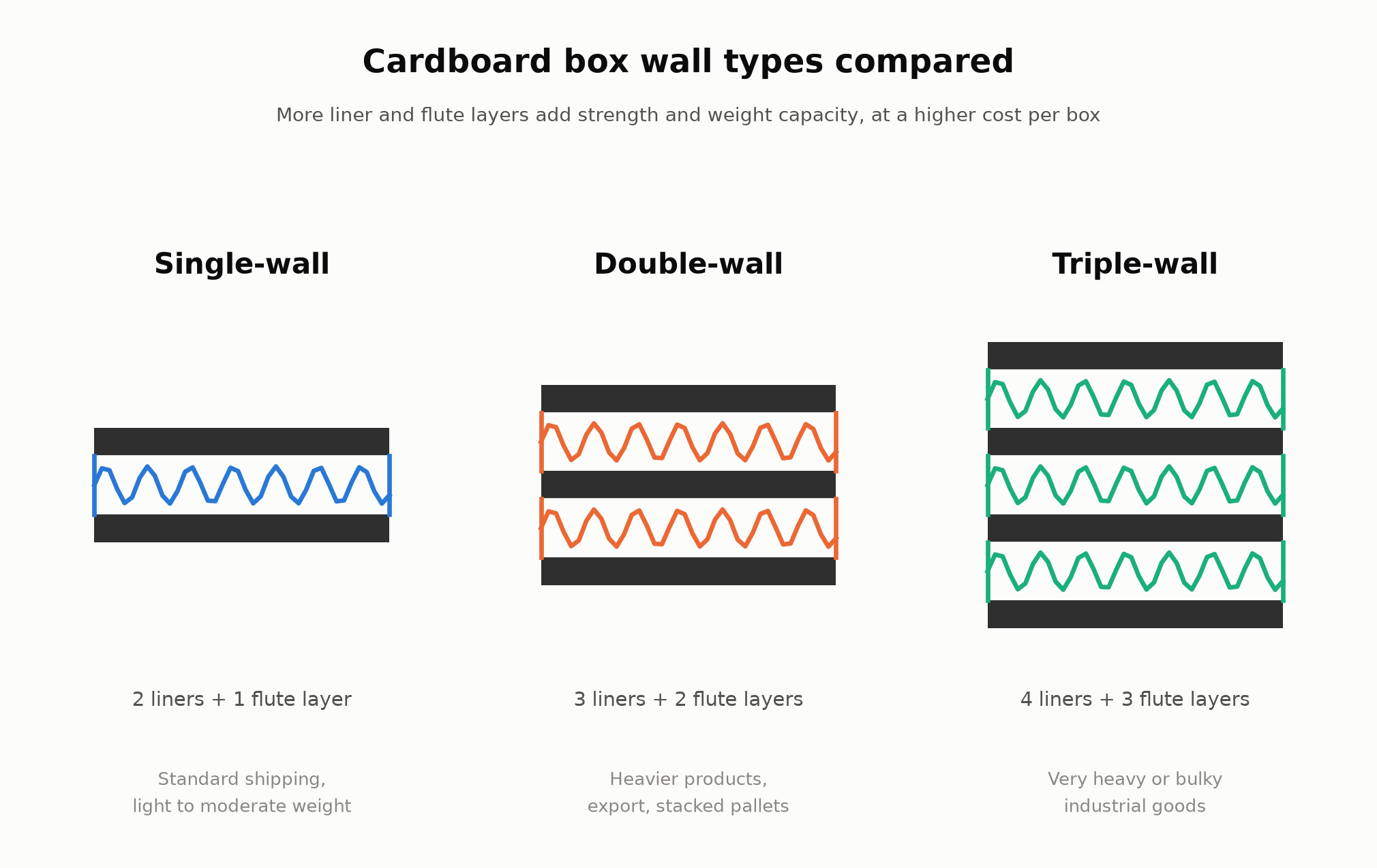
| Type | Best suited to |
|---|---|
| Single-wall | Standard shipping, light to moderate weight, single-leg freight |
| Double-wall | Heavier products, export or multi-leg freight, stacked pallet storage |
| Triple-wall | Very heavy or bulky industrial goods, high-stack pallet loads |
Choosing double-wall as a default “safer” option across an entire range, when most products would ship fine in single-wall, is a common way to overpay without realising it. The right choice depends on actual product weight and the freight path the box travels, not caution alone. See the wholesale cardboard box buying guide for how this plays out at volume.
Getting the size right
An oversized box costs more in two ways that compound on every single order: more void fill to stop the product moving, and a higher dimensional-weight freight charge, since carriers bill on the greater of actual and cubic weight. Profiling your actual product range against real box dimensions before committing to a stock size is a one-time check that then pays off on every order that follows. See our breakdown of what wrong-sized packaging actually costs, built from Australia Post’s own published cubic weight formula, for the full mechanics.
Recycled content and FSC certification
Recycled and FSC-certified cardboard is now close to standard stock pricing in most size ranges, there is rarely a real cost trade-off for choosing it. What matters is the claim behind the label: FSC certification and genuine recycled content are checkable facts, traceable to an actual certification body or a stated recycled-fibre percentage. A box marketed as “eco” or “sustainable” with no certification or figure behind it is a marketing label, not a verified claim. See the eco-friendly packaging materials guide for how to tell the two apart before it goes anywhere near your own packaging or marketing.
Stock sizes vs custom sizes
A stock size carries no tooling cost and is the right starting point if it genuinely fits your product. A custom die-cut size carries a one-off tooling cost that only makes sense once order volume justifies it, a smaller business is usually better served starting with the closest-fitting stock size and reviewing custom tooling once reorder volume is established, rather than committing to a custom box before volume is proven.
What to check before buying cardboard boxes in volume
- A stated dispatch time on a standing reorder, not a vague “fast delivery” claim.
- A real wholesale band structure, at what quantity the price actually steps down.
- Verifiable certifications, FSC, ISO 9001, ISO 14001, ISO 45001, rather than an unverified quality or sustainability claim.
- A sample check on your actual product weight before committing to a full order.
- Flat-pack and nesting dimensions against your actual warehouse storage space.
Common mistakes buying cardboard boxes for business
A handful of mistakes recur often enough to call out directly. Ordering one size across a varied product range to simplify the first order, then paying for wasted space and extra void fill on every shipment after. Defaulting to double-wall for everything out of caution, when single-wall would handle most of the range at lower cost. Buying from a general retailer at retail unit pricing well past the point where a proper trade account would be cheaper. And treating a sustainability label at face value without checking whether a real certification or recycled-content figure actually sits behind it.
Buying from a general retailer vs a trade account
A general retailer works fine for an occasional purchase, a handful of boxes for a one-off need, but it stops being the right choice well before most businesses actually switch away from it. Retail pricing is built for single-unit buyers, not for a business reordering the same formats monthly, and a proper trade account typically beats retail-equivalent pricing once genuine reorder volume exists, even at fairly modest quantities. The businesses still buying boxes from a general retailer at full retail price every month are usually paying more than they need to, simply because nobody has checked where the trade-account breakeven actually sits for their volume.
Sealing method matters as much as the box
A well-specified box with the wrong sealing method is only half a solution. Water activated tape bonds into the box’s own fibres as it dries and recycles with the carton; standard plastic tape sits on the surface and needs removing before the box can be recycled cleanly. Specifying box and tape together, rather than treating sealing as an afterthought once the box order is finalised, avoids a mismatch where a well-chosen box is let down by a seal that doesn’t hold under real handling conditions. See the water activated tape guide for how to specify this properly.
Who this matters for
- Ecommerce and retail businesses needing a right-sized range across their product catalogue.
- Manufacturers and distributors needing export-grade double or triple-wall cartons at genuine volume.
- Businesses with heavier or bulkier products, see our dedicated guide to heavy duty cardboard boxes for double and triple-wall specification.
- Growing businesses moving from retail-priced purchases into a proper trade account as order volume becomes predictable.
How Carewell Group helps
Carewell Group is an Australian packaging manufacturer and supplier, certified to ISO 9001:2015, ISO 14001:2015 and ISO 45001:2018, and an APCO member. We supply single-wall, double-wall and triple-wall cardboard boxes, including FSC-certified and recycled-content options, in stock and custom sizes, with trade pricing bands set against your actual volume and a sample process before you commit to a standing order.
Carewell can meet all your packaging needs for your business. Talk to our expert and we will work to your required MOQ. Call +61 (02) 8760 1491 or request a packaging review.
Seasonal volume and planning ahead
Cardboard box demand spikes hard around Black Friday and the Christmas period for most retail and ecommerce businesses, and a standard trade account sized for a normal month doesn’t scale automatically for a month shipping several times the usual volume. Forecasting your actual peak-season volume and placing that order ahead of the rush avoids competing with every other business doing the same thing in the same narrow window, see our Black Friday and Christmas packaging readiness guide for the full planning checklist.
Frequently asked questions
What’s the difference between single-wall and double-wall cardboard boxes?
Single-wall suits standard shipping at light to moderate weight. Double-wall costs more but suits heavier products, export freight, or stacked pallet storage.
Does recycled or FSC-certified cardboard cost more?
Usually not significantly, most recycled and FSC-certified stock is now close to standard pricing.
Is a custom box size worth it for a smaller business?
Only once your volume justifies the tooling cost. A close-fitting stock size is usually the better starting point.
Can I buy cardboard boxes at wholesale volume from Carewell?
Yes, see the wholesale cardboard box guide for how trade pricing bands work.
What tape should I seal cardboard boxes with?
Water activated tape bonds into the box’s own fibres and recycles with the carton, a more reliable and more sustainable seal than standard plastic tape sitting on the surface.
Sources
- Australia Post, cubic weight and parcel sizing: auspost.com.au
- Australian Packaging Covenant Organisation: apco.org.au
Written by Alif Vasaya, digital and content strategy, Carewell Group. Carewell Group is an Australian packaging, food packaging, tape, industrial safety and 3PL supplier serving all of Australia. Last updated 5 November 2026.