




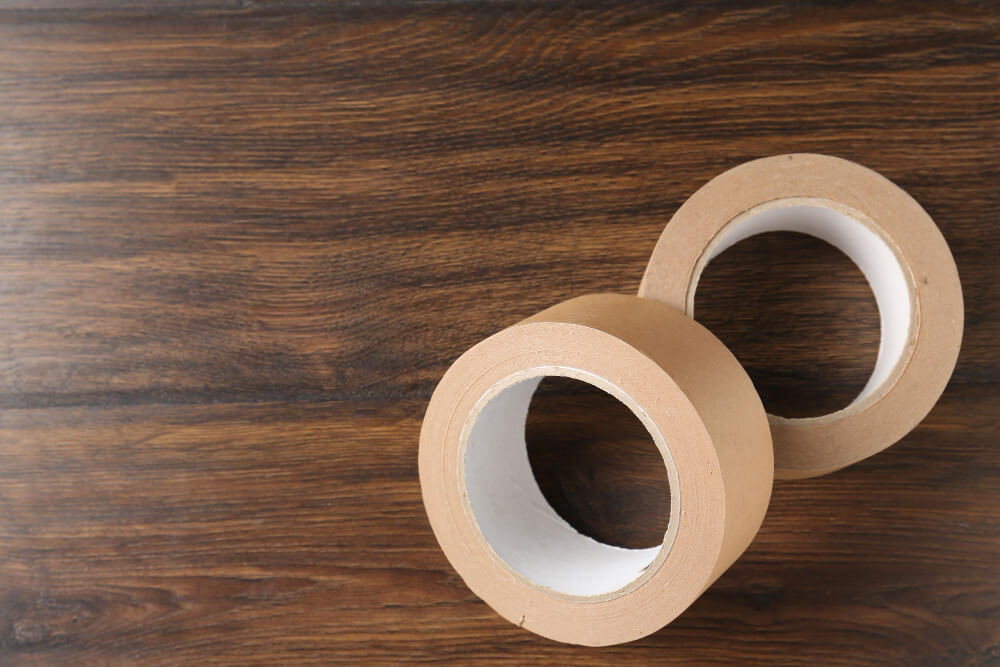
Most shipping cartons in Australia now carry a high proportion of recycled fibre. That is a good thing for the kerbside recycling loop, but it changes how a carton takes a seal: recycled-content board is dustier, more absorbent, more variable and more moisture-sensitive than virgin board. This guide explains why, and why a tape that bonds into the fibres holds on it where a surface adhesive can struggle.
Key points
- Every time paper is recycled the fibres get shorter, so recycled linerboard is weaker per gram and mills compensate with more fibre or an edge-crush (ECT) rated spec.
- The surface of recycled board has more loose fibre and dust and less sizing, so it is more absorbent and less consistent.
- That porous, absorbent surface suits water activated tape (the starch soaks in and bonds to the fibres) and can undermine pressure-sensitive tape (it grabs loose surface fibres that then let go).
- Recycled board softens faster in humidity and is more prone to creep, the slow slump of a stacked load, so the seal is under sustained stress.
- If seals fail on recycled board, check the board grade and the fill before blaming the tape.
What recycling does to the board
Corrugated board is made of cellulose fibres. Each time old corrugated cartons are pulped and re-formed, those fibres are cut a little shorter and lose some of their ability to bond to each other. Recycled linerboard therefore has lower tensile and burst strength for a given weight than virgin kraft.
Mills manage this in two ways: by using a heavier board (more grams per square metre to hit the same strength), or by specifying board to an edge crush test (ECT) value rather than a burst value, since ECT correlates well with how a stacked box actually performs. A well-specified recycled carton is perfectly strong; a carton that was light to begin with and is now mostly short recycled fibre is where problems show up.
The surface, and why it matters for tape
Recycled linerboard has more filler, more loose surface fibre, and less surface sizing than virgin kraft. Two consequences:
- It is more absorbent. Liquid, including a starch adhesive, soaks in rather than sitting on top.
- It is less consistent. Absorbency and surface strength vary between batches and even across a sheet.
For water activated tape, the absorbent surface is an advantage: the wetted starch penetrates the porous liner and hydrogen-bonds to the fibres, welding paper to paper. The bond is into the board, so it does not depend on a clean, sized surface.
For pressure-sensitive plastic tape, the loose surface fibre is a liability. The adhesive grabs the topmost fibres, but those fibres are only weakly attached to the liner beneath, so under load the tape peels away with a fuzz of fibre still stuck to it. This looks like a strong bond on the bench and fails in transit. Natural rubber adhesives cope better than acrylic here, but none match a fibre bond.
Moisture and creep
Recycled board absorbs moisture faster and loses stiffness faster than virgin board when humidity rises, and the fluted medium softens quickly. Under a stack of cartons in a warm, humid trailer or container, this shows up as creep: the load slowly slumps top to bottom over hours or days, and the seams are worked the whole time.
A seal that only has to survive a bench test can pass and still fail here, because the failure is slow and load-driven rather than a single impact. A fibre bond that holds the seam as one piece of board resists this better than tape that is holding two surfaces together.
At the pack bench
- Wipe the seam if the board is visibly dusty before applying tape. Dust is a bond killer for any adhesive.
- Keep board off the floor and out of damp corners; recycled board picks up moisture readily.
- Store flat and use stock in rotation so board is not sitting for months absorbing humidity before it is filled.
- Run a pull test on a sealed sample from each new board delivery, especially if you have changed carton supplier or grade.
When the board is not the problem
Recycled content gets blamed for failures that are really about specification or handling:
- The carton is under-specified for the weight it carries (too low an ECT rating).
- The carton is under-filled, so it collapses under stacking regardless of the seal.
- The bottom seam was sealed lightly and gave out under the contents’ own weight.
- The carton got wet.
Fix those first. A correctly specified, well-filled recycled carton with a fibre-bonding seal is a reliable shipper.
Reading a carton
The box maker’s certificate stamp on the bottom flap tells you the grade: either a burst strength (for example 200 lb test) or an ECT value (for example 32 ECT), plus the maximum gross weight and size limits. If you ship heavy on recycled board, specify to an ECT value and match the seal to it.
Where Carewell fits
Carewell Group is an Australian packaging supplier and manufacturer. We make recycled-content corrugated cartons to the right grade for your load and supply water activated tape that bonds into them, plus the dispenser to apply it consistently. For the grade choice see reinforced vs non-reinforced. Ask for samples or call +61 (02) 8760 1491.
Frequently asked questions
Does tape stick to recycled cardboard?
Water activated tape does well, because its starch adhesive soaks into the absorbent surface and bonds to the fibres. Pressure-sensitive plastic tape can grip loose surface fibres that then pull away under load, so it is less reliable on high-recycled-content board.
Why do my boxes fail in transit but pass on the bench?
Often creep: recycled board softens under humidity and a stacked load slowly slumps over hours, working the seams the whole time. A bench test does not reproduce that. Check the board grade and fill as well.
Is recycled cardboard weaker?
Per gram, yes, because recycled fibres are shorter. Mills compensate with heavier board or an ECT-rated spec, so a well-specified recycled carton is strong. A carton that was light to start with is the risk.
Should I wipe the box before taping?
If it is visibly dusty, yes. Dust weakens any adhesive bond, and recycled board sheds more surface fibre and filler.
What does the stamp on the bottom of the box mean?
It is the box certificate: a burst strength or an ECT value, plus maximum weight and size. Use it to check the carton is rated for what you are putting in it.
Sources
- ScienceDirect and BioResources, humidity effect on compressive deformation and failure of recycled vs virgin corrugated board (moisture uptake, creep): sciencedirect.com
- Edge crush test (ECT) and box compression correlation, corrugated packaging references
- Old corrugated container recycling and fibre shortening, US patent literature on recycled linerboard
Written by Alif Vasaya, digital and content strategy, Carewell Group. Carewell Group is an Australian packaging, food packaging, tape, industrial safety and 3PL supplier. Last updated 10 September 2026.