




Once you have decided to seal cartons with water activated tape, there is really only one specification that decides whether the seal holds: the grade. Reinforced or non-reinforced. Get that right and a single centre strip holds a heavy carton through a depot sort. Get it wrong and the tape splits, the flaps lift, and the carton is the one that comes back.
This guide is only about that choice. If you are still weighing water activated tape against plastic tape in general, start with our water activated tape guide and come back here when you are ready to spec a roll.
Key points
- Non-reinforced is plain gummed kraft and starch. It suits light, single-wall cartons and palletised loads, and it is the cheapest and most widely recycled option.
- Reinforced has fibreglass threads laminated between two kraft sheets, running lengthways and across. That is what lets one strip hold a heavy carton through parcel handling.
- Match the grade to the carton weight and how rough the transit is, not to the tape budget. The tape is a small line item; a failed carton is not.
- Both grades bond into the board and both are tamper-evident. The difference is tensile strength, not stickiness.
- Reinforced contains glass filaments, so its kerbside recycling story has one extra caveat. Non-reinforced does not.
The two grades, physically
Non-reinforced water activated tape is two things: a kraft paper carrier and a dry starch-based adhesive. Wet it, and the starch bonds into the top fibre layer of the carton. There is nothing in the tape to stop it tearing along its length if the carton works hard in transit, so its job is light cartons and loads that are strapped to a pallet rather than thrown onto a parcel belt.
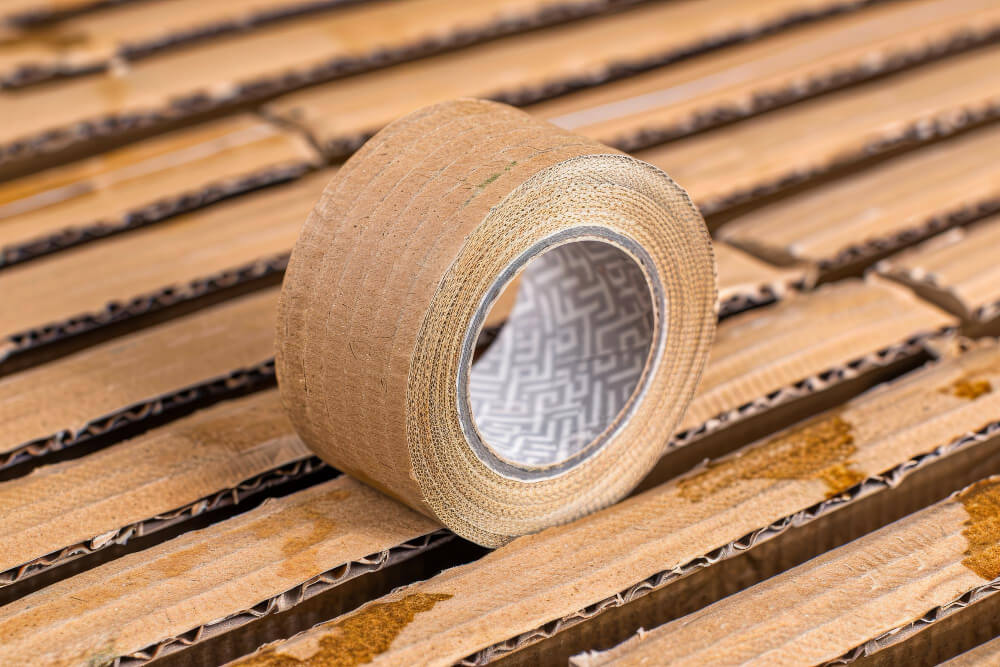
Reinforced water activated tape adds a third layer: a scrim of fibreglass yarns laminated between two kraft sheets. The yarns run in the machine direction (along the roll) and across it, so the tape resists splitting and stretching in both directions. This is the grade sold for carton sealing without corner tabs, where one centred strip does the whole job.
Reinforced tape is usually sold by a grade number that maps to a carton weight. As a rough guide, drawn from the common Central-style grading:
- 240 grade seals cartons up to about 13 kg (30 lb)
- 250 grade up to about 23 kg (50 lb)
- 260 grade up to about 25 to 27 kg (55 to 60 lb)
- 270 grade up to about 34 kg (75 lb)
Different mills label their grades differently, so treat the numbers as a family, not a standard. The width is the other variable: 70 to 72 mm is the standard carton-sealing width in Australia, on rolls around 100 to 150 m. Narrower 48 mm rolls exist for small cartons and mailers.
Match the grade to the carton, not the budget
Three questions settle almost every case.
1. How heavy is the packed carton?
- Under about 5 kg, single-wall box or a paper mailer: non-reinforced is enough. The carton itself will fail before a correctly applied strip does.
- 5 to 15 kg: this is the grey zone. Non-reinforced will usually hold if the carton is single-wall, well filled and not over-stuffed, and if it travels palletised. If it ships as an individual parcel, move to a light reinforced grade (around 240).
- 15 to 30 kg: reinforced, mid grade (around 250 to 260).
- Over 30 kg, or double-wall export cartons: reinforced heavy grade (260 to 270), and consider a wider strip.
2. What is the carton made of?
Water activated tape bonds into single-wall, double-wall and recycled-content board because the adhesive penetrates the flute fibres. But a double-wall carton is heavier and is usually carrying more, so it pulls harder on the seal. Double-wall almost always means reinforced. High recycled-content board can have a dustier, less absorbent surface, which is another reason to move up a grade rather than down.
3. How rough is the journey?
- Palletised, kept as a unit load, short domestic leg: non-reinforced covers a lot of this.
- Individual parcel through a carrier network: every carton gets sorted, dropped and stacked under others. Reinforced.
- Export, long transit, multiple handling points, humidity swings: reinforced heavy grade every time. See why water activated tape suits export shipments.
By industry, what most operations land on
E-commerce fulfilment and 3PL. Mixed-weight cartons, all shipped as individual parcels, all handled hard. Most fulfilment benches standardise on a single reinforced grade (240 to 250) so packers never have to choose, and keep non-reinforced only for a light-mailer line. Standardising on one grade also simplifies buying and training.
Contract packing and co-manufacturing. Output is usually palletised in unit loads for retail distribution centres, not parcel-shipped. Non-reinforced handles a large share, with reinforced reserved for heavy shippers and any carton that will be broken out and sent on individually.
Food and beverage distribution. Heavier cartons (cans, jars, bottles), often double-wall, often stacked several high. Reinforced mid to heavy grade. The recyclability of the whole carton matters here for retailer packaging scorecards, which is a point in water activated tape’s favour over plastic.
Industrial and manufacturing. Parts, tools, spares: dense, heavy, sharp-cornered. Reinforced heavy grade, and pair it with a double-wall carton and edge protection rather than asking the tape to compensate for an under-specified box.
Subscription boxes and premium direct-to-consumer. Light contents, but the brand wants a clean single strip and a tamper-evident open. Non-reinforced, usually custom-printed, is the common choice, moving to light reinforced only if the box is on the larger side.
How each grade fails, honestly
Non-reinforced, used above its weight. The classic failure looks like an adhesive problem but is not. The strip splits along its length, or stretches and lets a flap lift, because the paper carrier simply does not have the tensile strength for the load. People often respond by adding a second and third strip, which uses more tape and more time and still does not fix the root cause. The fix is a higher grade, not more tape.
Non-reinforced on a poor surface. A damp, dusty, waxed or heavily coated carton will not give the starch anything to bond into. This affects both grades, but non-reinforced has less margin, so it shows up there first.
Reinforced, used well below its weight. Not a safety failure, a cost one. You are paying for fibreglass you do not need on a 2 kg subscription box, and the recycling caveat below applies for no benefit. Reinforced is not a default; it is a grade you step up to.
Reinforced and dispensing. The fibreglass that makes the tape strong also makes it tougher to cut. A light manual dispenser meant for non-reinforced tape will struggle. Match the dispenser to the grade (see below).
Reinforced and recycling: the honest answer
Non-reinforced water activated tape is paper and plant starch. A carton sealed with it goes straight into kerbside paper and cardboard recycling with the tape left on. No caveat.
Reinforced tape contains fibreglass filaments. Most Australian material recovery facilities still accept a cardboard carton sealed with reinforced water activated tape, because the glass content is small and the paper is the dominant material. A minority of facilities ask for the tape to be removed first. The practical guidance:
- Follow the Australasian Recycling Label on your own packaging and, if you are specifying at volume, ask your recycler directly.
- If a fully kerbside-friendly carton with no caveats is the goal, use non-reinforced wherever the carton weight allows it, and save reinforced for the heavy cartons where there is no alternative.
- Either grade still beats plastic tape, which should be pulled off the carton before recycling and usually is not.
For a genuinely single-material parcel, pair the tape with a kraft carton and paper void fill, and with kraft paper mailers or honeycomb paper mailers for the items that do not need a box.
Dispenser and width pairing
- Non-reinforced, low to moderate volume: a manual pull-and-tear dispenser is fine and inexpensive.
- Reinforced, any volume: use a dispenser rated for reinforced tape. The glass scrim blunts light cutters. For a bench sealing more than roughly 50 to 100 cartons a day, an electric dispenser that pre-measures and wets each strip pays for itself in speed and consistency. Our water activated tape dispenser guide covers manual, electric and automatic.
- Width: 70 to 72 mm is the standard carton-sealing width and suits most cartons up to a large mailer box. Step to a wider strip only for very heavy or oversized double-wall cartons. Narrow 48 mm is for small cartons and mailers.
A quick self-test before you commit
Pack three of your real cartons at their heaviest realistic weight. Seal each with a single centre strip of the grade you are considering, in an H pattern (one strip along the centre seam, one across each end). Let them dry for an hour, then try to pull the top flaps apart by hand and drop each carton onto a hard floor from bench height.
- If the board tears before the seal gives, the grade is right.
- If the tape splits or peels first, go up a grade.
- If the seal holds easily on a light carton, you may be able to go down a grade and save.
How Carewell Group fits: one partner from spec to dispatch
Carewell Group is an Australian packaging manufacturer and supplier, not a reseller of one product line. We design custom packaging around your product, add your branding and print, and supply the whole dispatch line from one place, so getting the tape grade right is not another project your team has to run.
- Reinforced and non-reinforced water activated tape in the grades and widths that match your cartons, plain or custom-printed with your logo in water-based inks. For a ready e-commerce grade see the CWG KRWAT E110 reinforced water activated tape.
- Dispensers matched to the grade, from manual to electric to automatic.
- The carton and the void fill to go with it, so the whole parcel is one material stream: kraft cartons, kraft paper mailers and honeycomb paper mailers.
- Custom design and engineering. If your product needs a specific carton, insert or seal, we build it to fit rather than making you adapt to stock sizes. From engineering to finished, ready-to-use packaging, your business gets a solution, not another task.
- Browse the full water activated tape range or the reinforced water activated tape products.
Carewell operates from NSW with warehousing in Smithfield, Matraville and Padstow, works with clients across grocery and retail, e-commerce, food and beverage, and industrial and manufacturing, and is certified to ISO 9001:2015, ISO 14001:2015 and ISO 45001:2018, and an APCO member.
Not sure which grade your range needs? Request a quote and samples or call +61 (02) 8760 1491 and we will spec it against your actual cartons.
Frequently asked questions
Is reinforced water activated tape always the safer choice?
For heavy or hard-handled cartons, yes. For light single-wall cartons and mailers it is over-specification: you pay for fibreglass you do not need and add a small recycling caveat for no benefit. Match the grade to the carton.
What weight can reinforced water activated tape hold?
It depends on the grade. Light reinforced grades are rated to around 13 kg per carton, mid grades to around 23 to 27 kg, and heavy grades to around 34 kg, using a single centred strip. Heavier cartons need a heavy grade and often a wider strip.
Can I recycle a carton sealed with reinforced tape?
In most of Australia, yes, in the kerbside cardboard stream. A minority of facilities ask for reinforced tape to be removed first because of its fibreglass filaments. Non-reinforced tape has no such caveat. Check the Australasian Recycling Label for your packaging.
Do reinforced and non-reinforced use the same dispenser?
Not always. The fibreglass in reinforced tape blunts light manual cutters, so use a dispenser rated for reinforced tape. Electric dispensers handle both.
Can both grades be custom-printed?
Yes. Both take custom print well, normally in water-based inks so the carton stays recyclable.
Sources
- Central / Intertape water activated tape grade ratings (240 to 270 grades and carton weights): itape.com
- EcoEnclose and Holland Manufacturing, non-reinforced vs reinforced application guidance: hollandmfg.com
- Jota Machinery, gummed kraft paper tape fibre-bonding and troubleshooting notes: jotamachinery.com
- Australasian Recycling Label (ARL) program: recyclingnearyou.com.au
- Australian Packaging Covenant Organisation (APCO): apco.org.au
Written by Alif Vasaya, digital and content strategy, Carewell Group. Carewell Group is an Australian packaging, food packaging, tape, industrial safety and 3PL supplier. Last updated 9 September 2026.