






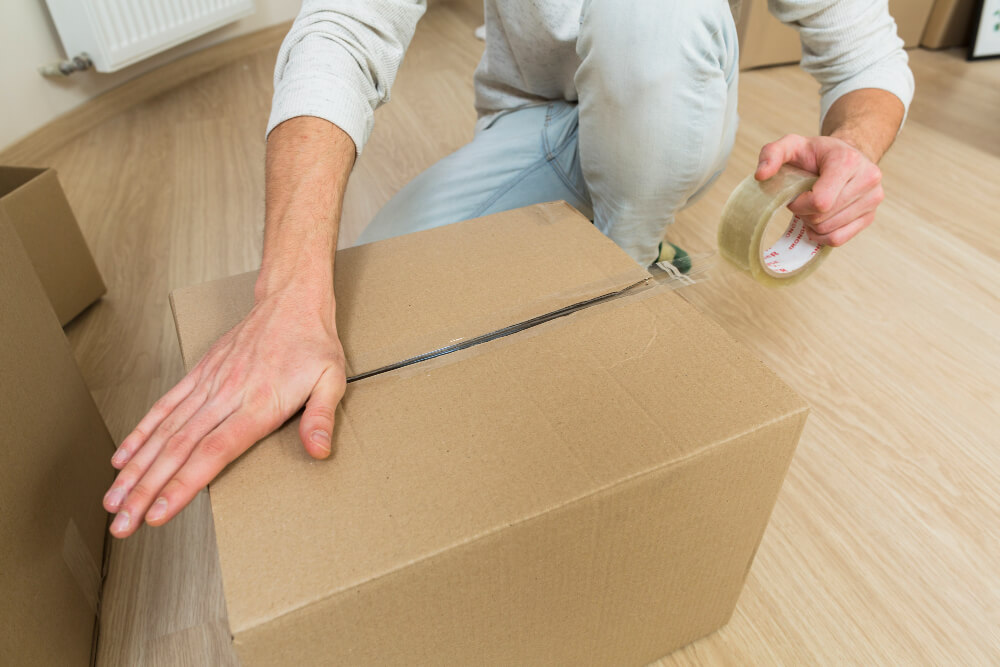
The seal a carton needs is decided by how the carton is built. A regular slotted box with a gap down the centre seam is a different sealing job from a full-overlap box, a tray-and-lid, or a die-cut mailer box. This guide walks the common corrugated styles and the taping each one wants, using water activated tape as the reference because its fibre bond makes the pattern easy to see working.
Key points
- The regular slotted container (RSC) has flaps that meet but do not overlap, so the centre seam is the weak line and needs a full-length strip.
- Full-overlap (FOL) boxes are stronger by construction; the seal job is a longer strip, not a heavier one.
- Trays with separate lids are sealed at the lid-to-tray join, often with an L-clip or banding, not an H.
- Die-cut mailer boxes are usually designed to close without tape; a single discreet strip or sticker is enough.
- Double-wall cartons want reinforced tape, a wider strip, and a full H-pattern on both faces.
Regular slotted container (RSC)
The default shipping box: one piece of board, four flaps of equal length that meet in the centre when folded, and inner flaps that do not reach each other. Because the outer flaps only butt together, the centre seam is a straight line with nothing bridging it.
Seal: a full H-pattern. One strip along the centre seam with 50 to 75 mm of overhang past each end, and one strip across each end seam where the flap meets the side panel. Do the bottom the same as the top. On heavier RSCs, add a C-clip (the centre strip wrapping down onto the end panels).
Where it fails: a centre strip that stops short of the ends, or no end strips, so the corners lever open under stacking.
Full-overlap slotted container (FOL)
Same idea as an RSC, but the outer flaps are long enough to fully overlap across the top and bottom. That double layer of board resists crushing and stops anything falling through the seam, which suits heavy or top-loaded contents.
Seal: because the flaps overlap, a single strip along the leading edge of the top flap, plus a strip across each end, is often enough. The strip needs to be longer to reach past the overlap. The construction is already strong; you are sealing it shut, not reinforcing it.
Half-slotted container (HSC) and tray-and-lid
An HSC is an RSC with one set of flaps removed, leaving an open-topped tray. It is used with a separate lid (a shallow tray inverted over the top) or as a component in a two-piece box.
Seal: tape the join where the lid skirt meets the tray wall, on all four sides or at least the corners (an L-clip at each corner). For heavier trays, band the whole assembly with strapping and use tape to hold the lid square while it is banded.
Die-cut mailer box
The fold-flat “book style” box with a front tuck flap and side wings, popular for direct-to-consumer. Most are designed to close by tucking, and many have a peel-and-seal adhesive strip built in.
Seal: if there is a peel strip, no tape is needed. If not, one short strip across the tuck flap, or a branded sticker, keeps it shut without covering the printed artwork. A full H-pattern here looks heavy-handed and hides the design. For anything heavier than light goods, this is the wrong box style, not a taping problem.
Telescope and two-piece boxes
A separate base and lid that slide over each other (the lid “telescopes” down). Common for documents, apparel and gift packaging.
Seal: a strip at each end spanning the lid-to-base overlap, or a band around the girth. If the lid is deep enough to cover most of the base, corner L-clips are usually sufficient.
Double-wall cartons
Two fluted layers instead of one, for heavy, dense, or export goods. The board is thicker and stiffer, and the carton is carrying more, so it pulls harder on the seal.
Seal: reinforced water activated tape, a wider strip (up to 76 mm), and a full H-pattern on both faces. Pair with edge protection rather than expecting the tape to compensate for a heavy load. See reinforced vs non-reinforced.
Bliss boxes and pre-glued trays
Boxes assembled from a body and one or two end pieces, glued at the factory into a strong three-panel wrap. The bottom is already closed; only the top needs sealing.
Seal: a single centre strip plus end strips on the top face. The glued construction does the structural work.
Closure patterns, quick reference
- Single strip: centre seam only. Light cartons, reinforced tape, or strong glued constructions.
- H-pattern: centre seam plus each end seam. The default for an RSC.
- C-clip: centre strip wrapping partway down each end panel. Heavier RSCs.
- L-clip: a strip bent around each corner. Trays and lids.
- Full band / strapping: around the girth. Heavy trays and two-piece boxes.
The two things that matter more than the pattern
Fill the box. A carton with a lot of void space collapses under stacking regardless of the seal. Right-size the carton or add void fill.
Seal the bottom properly. The bottom seam carries the contents’ weight in transit and is the most common failure point across every box style.
Where Carewell fits
Carewell Group is an Australian packaging supplier and manufacturer. We make corrugated cartons in the style that suits your product and supply the tape and dispenser to match, so the box and the seal are specified together. For technique, see how to use water activated tape; for the product range, water activated tape. Ask for samples or call +61 (02) 8760 1491.
Frequently asked questions
What taping pattern does a standard shipping box need?
A regular slotted container needs a full H-pattern: one strip along the centre seam with overhang past each end, and one strip across each end seam, on both the top and the bottom.
Do full-overlap boxes need less tape?
They need a longer strip to reach past the overlapping flaps, but the construction is already strong, so a single top strip plus end strips is often enough rather than a heavy multi-pass seal.
How do I seal a die-cut mailer box?
Most are designed to tuck closed or have a built-in peel-and-seal strip. If not, one short strip across the tuck flap or a branded sticker is enough; a full tape pattern covers the artwork.
How do I seal a box with a separate lid?
Tape the join where the lid meets the base, with an L-clip at each corner or a strip along each side. Band heavier assemblies around the girth.
What seal does a double-wall carton need?
Reinforced tape, a wider strip, and a full H-pattern on both faces, plus edge protection for heavy contents.
Sources
- PakFactory and Refine Packaging, corrugated box styles (RSC, FOL, die-cut, mailer boxes) and how they close: refinepackaging.com
- Cubit Packaging and Meridian, RSC / HSC / FOL construction and sealing: cubitpackaging.com
- Fibre Box Association carton style conventions
Written by Alif Vasaya, digital and content strategy, Carewell Group. Carewell Group is an Australian packaging, food packaging, tape, industrial safety and 3PL supplier. Last updated 10 September 2026.