






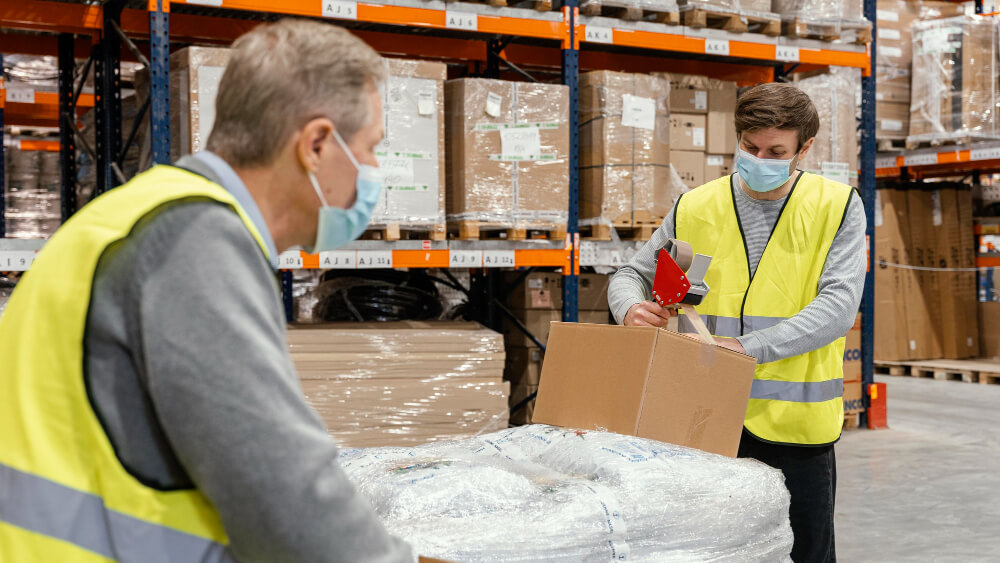
The pick and pack process is the sequence a warehouse follows to turn a customer order into a labelled parcel ready for a carrier. It sounds simple, and the steps are, but it is where most of a fulfilment operation’s cost, speed and error rate are decided. This guide walks through the full process, the picking methods used, the points where money and time leak, and the role packaging plays in every one of them.
What “pick and pack” means
Pick and pack is the middle of the fulfilment chain. Stock has already been received and stored; delivery happens afterwards. In between, the warehouse:
- Picks: locates and collects each item in an order from its storage location.
- Packs: checks the items, protects them, seals them into a shipping outer and labels the parcel.
Everything else, slotting, picking strategy, quality checks, weighing, manifesting, exists to make those two actions fast and accurate. For the wider context, see the pick and pack overview.
The pick and pack process step by step
- Receiving and put-away. Inbound stock is checked against the purchase order and placed into storage locations that are recorded in the system.
- Slotting. Fast-moving SKUs are placed close to the pack area and at an easy height; slow movers go further out. Good slotting cuts walking time more than any other single change.
- Order release. Orders flow in from sales channels and are grouped into pick lists or waves, often by carrier cut-off, zone or priority.
- Picking. A picker follows the list, usually on a device, scanning each item to confirm the right SKU and quantity.
- Verification. Picked items are checked against the order, by scan at a put wall or at the pack bench, before anything is sealed.
- Packing. The packer chooses the smallest outer that fits, adds only the protection the format does not already provide, and seals it.
- Weighing and labelling. The parcel is weighed, the carrier label and any customs or dangerous-goods documentation is applied, and it is added to the manifest.
- Dispatch. Parcels are staged by carrier in a marked area for the scheduled pickup.
- Tracking and reconciliation. Tracking flows back to the customer; stock and orders are reconciled so the system matches the shelf.
Methods of picking
| Method | How it works | Best for |
|---|---|---|
| Single-order (discrete) | One picker completes one order at a time | Low volume, large or complex orders |
| Batch | One picker collects the same SKU for many orders in one trip, then sorts | High volume of small orders sharing SKUs |
| Zone | Each picker works one area; orders pass between zones | Large warehouses, wide SKU range |
| Wave | Orders released in timed groups aligned to carrier cut-offs | Operations with several daily dispatch deadlines |
| Cluster | One picker fills several orders at once into a divided trolley or tote | Small multi-line orders |
Most operations start with single-order picking and move to batch or zone as volume grows.
Where the process leaks money and time
- Walking. Travel between locations is the largest non-productive part of picking. Slotting and batching attack it directly.
- Mis-picks. The wrong item or quantity becomes a return, a re-ship and often a lost customer. Scanning at pick and at verification is the fix.
- Box selection. A packer deciding which size to use for every order, then folding it flat, loses time on every parcel.
- Slow sealing. Multiple passes of plastic tape, or seals that fail and need redoing, add seconds that compound across a shift.
- Oversized parcels. Carriers bill on the greater of actual and dimensional (cubic) weight, so a half-empty box is charged for air, and it needs void fill packed around the contents.
- Off-bench weighing. Walking parcels to a separate scale or terminal breaks the flow.
The role of packaging in the pick and pack process
Packaging is not the last cosmetic step. It is one of the biggest levers on the whole process.
A short, staged format range
Two or three satchel sizes, one or two padded sizes and two or three carton sizes cover the large majority of orders. Fewer choices means the packer sizes an order by glance. Keep every format pre-opened and stacked within arm’s reach.
Right-sized outers
Matching the outer to the contents cuts dimensional-weight freight charges and removes the need to pack void fill around a loose item. Profile a week of real orders by size to find the right set of formats. See where pick and pack fees come from.
One-motion sealing
Peel-and-seal satchels close in one action. For cartons, a water activated tape dispenser lays a single measured strip that bonds into the board and holds first time, with no second pass. This is one of the largest per-parcel time savings available.
Protection built into the format
A padded or honeycomb mailer for small fragile items removes the separate wrapping step.
Returns designed in
Resealable mailers and clean-opening cartons keep a return recoverable in the same packaging.
Best practices for pick and pack efficiency
- Slot fast movers near the pack area.
- Batch or zone pick once single-order picking cannot keep up.
- Scan at pick and again at verification.
- Profile orders and run the smallest viable format range.
- Stage packaging by size at the bench; scale and label printer on the bench.
- Standardise one closure method per format.
- Set an honest carrier cut-off and protect it.
- Reconcile stock daily so the system matches the shelf.
In-house or outsourced?
Businesses often look at a fulfilment provider when the process feels slow. Sometimes the volume and complexity genuinely warrant it. Often the process is fine and the pack bench was never designed. Fix the bench, then judge honestly whether a third party adds enough to justify its per-order fees. Work through contract packing versus smart in-house packaging. If you do outsource, you still define the packaging spec the provider packs to.
How Carewell Group helps
Carewell Group is an Australian packaging manufacturer and supplier, and a 3PL and industrial supply partner. For the pick and pack process we provide:
- Poly satchels, kraft paper mailers and recyclable honeycomb padded mailers in matched size ranges.
- Right-sized cartons, paper void fill, edge protection and water activated tape with dispensers.
- Custom print on mailers and tape so branding adds no pack time.
- A parcel-profiling review: send a week of order dimensions and we will recommend the three or four formats that cut freight and pack time.
Carewell can meet all your packaging needs for your business. Talk to our expert and we will work to your required MOQ. Call +61 (02) 8760 1491 or request samples and a sizing review. See also pick and pack solutions, cycle time and fulfilment services.
Frequently asked questions
What is the pick and pack process in a warehouse?
The sequence of locating and collecting each item in a customer order, checking it, packing it into a shipping outer and labelling it for a carrier. It sits between receiving and delivery.
What are the steps in pick and pack?
Receiving and put-away, slotting, order release, picking, verification, packing, weighing and labelling, dispatch, then tracking and reconciliation.
What are the main picking methods?
Single-order, batch, zone, wave and cluster picking. Operations usually start single-order and move to batch or zone as volume grows.
How does packaging affect the process?
A short staged range of right-sized formats speeds the pack bench, right-sizing cuts dimensional-weight freight, one-motion sealing saves time on every parcel, and the right format builds in protection and returns handling.
Should I outsource the pick and pack process?
Only once the pack bench is set up well and the volume or complexity genuinely exceeds what you can run in-house. You still set the packaging spec.
Sources
- MHI, order-picking fundamentals: mhi.org
- Australia Post, cubic weight and parcel sizing: auspost.com.au
Written by Alif Vasaya, digital and content strategy, Carewell Group. Carewell Group is an Australian packaging, food packaging, tape, industrial safety and 3PL supplier serving all of Australia. Last updated 10 September 2026.