






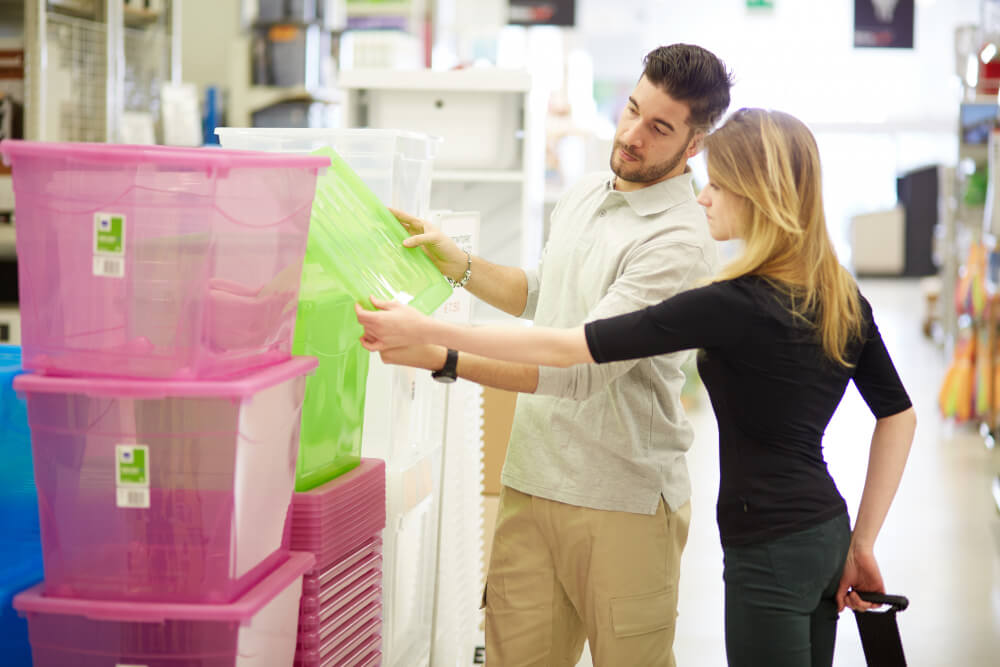
Bins are the quiet workhorses of a pick and pack line. Every order spends time in one: a pick tote on a trolley, an order bin on a put wall, a batch container on a conveyor. Get the bin strategy right and picking is faster and more accurate. But the bin is only half the story. What the order is packed into when it leaves the bin, the satchel or the carton, is where your freight cost and your damage rate are actually decided. This guide covers both: how to use pick and pack bins well, and how to connect that to the outbound packaging so the whole line is efficient.
What “pick and pack bins” means
In a fulfilment operation, bins and totes appear at several points:
- Pick totes carried on a trolley or cart while a picker walks the aisles collecting items.
- Order bins on a put wall or sortation rack, one slot per open order, where items are consolidated after a batch pick.
- Batch or cluster containers that hold several orders at once during a multi-order pick, often divided into compartments.
- Storage bins on shelving that hold small, loose SKUs so pickers grab from a defined location rather than hunting.
- Returns bins for goods coming back that need inspection before they rejoin stock.
Used together, they turn picking from a series of individual trips into a batched, organised flow. For the full sequence they sit inside, see the pick and pack process.
Why a bin strategy speeds up picking
Batch picking instead of single-order trips
A divided batch container lets a picker collect items for eight or twelve orders in one walk of the warehouse, then sort them into order bins at a pack station. That can cut walking time per order dramatically compared with picking one order at a time.
Fewer mis-picks
When each open order has its own bin or put-wall slot, and the picker scans the item and the slot, the wrong item in the wrong order becomes hard to do by accident. Mis-picks are one of the biggest hidden costs in fulfilment because each one becomes a return, a re-ship and often a lost customer.
A logical, repeatable workflow
Bins impose order. Stock lives in a labelled bin location, picks land in a numbered tote, orders consolidate in a slot. New staff get productive faster and the operation is easier to audit.
Better use of space for small SKUs
Small, loose items such as accessories, hardware, cosmetics or spare parts store far more densely in shelf bins than on open shelving, and they are quicker to pick because the location is exact.
Choosing and sizing bins
| Decision | Guidance |
|---|---|
| Bin size | Match the tote to your typical order cube. A tote much larger than the average order wastes trolley space and encourages over-picking; one that is too small forces extra trips. |
| Stackable vs nesting | Stackable totes hold shape when full and stack on a pallet for transport. Nesting totes collapse into each other when empty to save return-transport space. Many operations use stack-nest totes that do both. |
| Dividers | Compartment inserts let one container carry several small orders during a batch pick without items mixing. |
| Colour coding | Different tote colours for pick, pack, returns and quality-check stops errors at a glance. |
| Labelling | A barcode or RFID label on every tote so it can be scanned to an order, a zone or a stage. |
Carewell Group does not supply warehouse storage totes, but the sizing logic above feeds directly into the decision we can help with: what the order is packed into when it leaves the bin.
From the bin to the parcel: where cost is actually set
An order sitting in a pick tote is not a shipment yet. It becomes one when it is packed into an outer and labelled. That outer choice drives two numbers that dwarf the cost of the bins:
- Freight. Carriers bill on the greater of actual and dimensional (cubic) weight. A small order packed into an oversized box is charged for air. Right-sizing the outer to the contents of the bin is the biggest single lever on shipping cost. More detail in where pick and pack fees come from.
- Damage and returns. An under-protected item in a loose box arrives damaged; an over-packed one wastes material and pack time. The right format for the product removes both.
The practical move is to profile what your bins actually hold. Weigh and measure a week of real orders, group them by size, and you will usually find three or four outbound formats cover almost everything.
Matching the outer to what is in the bin
| What the bin holds | Best outbound format |
|---|---|
| One or two soft, non-fragile items (apparel, textiles) | Right-sized poly satchel or kraft paper mailer |
| Small items with some fragility (cosmetics, electronics accessories, trims) | Recyclable honeycomb padded mailer |
| Multi-item orders, rigid or awkward goods | Right-sized carton with paper void fill and water activated tape |
| Heavy or high-value orders | Double-wall carton, reinforced tape, edge protection |
Stock these formats pre-opened at the pack bench in the same way you stage your totes, and the pack decision becomes a glance rather than a hunt. Compare formats in padded mailers vs mailing boxes.
“Pick and pack bags”: the outbound version
Some teams use “pick and pack bags” to mean the poly satchels and mailers orders are packed into, rather than the totes they are picked into. For that, the same right-sizing rule applies:
- Run two or three satchel sizes, not one. One for single items, one for two-to-three item orders, one larger.
- Choose opaque or grey film so contents are not visible through the bag.
- Use a dual peel-and-seal strip so the customer can reseal the same bag for a return.
- Switch to paper mailers where a plastic-free or recyclable outer matters to your customers, with a liner for wet-weather lanes.
A bin-to-pack setup that works
- Zone your storage so fast-moving SKUs are in easy-reach bins near the pack area.
- Batch pick into a divided container, scanning item and slot.
- Consolidate into per-order bins on a put wall.
- Profile the order at the bench: the packer sees the bin contents and picks the smallest outer that fits.
- Stage packaging like totes: satchels and cartons pre-opened by size within arm’s reach.
- Seal in one motion with peel-strip satchels or a water activated tape dispenser.
- Weigh and label at the bench so freight is billed on the real parcel.
How Carewell Group helps
Carewell Group is an Australian packaging manufacturer and supplier. We do not sell warehouse storage bins, but we supply everything the order is packed into once it leaves the bin:
- Poly satchels, kraft paper mailers and recyclable honeycomb padded mailers in matched size ranges.
- Right-sized cartons, void fill, edge protection and water activated tape.
- Custom print on mailers and tape so dispatch is branded without extra pack time.
- A parcel-profiling review: send us a week of order dimensions and we will recommend the three or four formats that cut your freight and pack time.
Carewell can meet all your packaging needs for your business. Talk to our expert and we will work to your required MOQ. Call +61 (02) 8760 1491 or request samples and a sizing review. For the bigger picture, see pick and pack solutions and the pick and pack overview.
Frequently asked questions
What are pick and pack bins used for?
They hold orders through the fulfilment line: pick totes during picking, order bins for consolidating a batch pick, divided containers for multi-order picks, shelf bins for small SKUs, and returns bins for goods coming back.
How do bins make picking faster?
They enable batch picking, where one warehouse walk collects items for many orders at once, and they reduce mis-picks because each order has its own scannable slot.
What size should a pick tote be?
Match it to your typical order cube. Too large wastes trolley space and invites over-picking; too small forces extra trips. Profile a week of real orders to find the right size.
How do bins relate to shipping packaging?
The bin stages the order; the outbound satchel or carton is where freight cost and damage risk are set. Right-size the outer to what the bin holds, and stage packaging by size at the bench the way you stage totes.
Does Carewell sell warehouse bins?
No. Carewell supplies the outbound packaging: satchels, mailers, cartons, void fill and tape, plus sizing advice to match those formats to your orders.
Sources
- Australia Post, parcel satchel sizes and pricing bands: auspost.com.au
- MHI, warehouse order-picking and tote handling practice: mhi.org
Written by Alif Vasaya, digital and content strategy, Carewell Group. Carewell Group is an Australian packaging, food packaging, tape, industrial safety and 3PL supplier serving all of Australia. Last updated 10 September 2026.